
 M. DAWSON
 J. CLARKE
 M. SMOLEN
 E. FER
 C. KUHNLE
 M. CHOURRAUT
 M. BENUS
 F. ANTON
 L. BOZIC
 K. HOSKOVA
 J. FOX
 BREZINSKI/BREZINSKI

 A. PETERS
 V. KHUDZENKA
 E. MEDVECKZKY
 GRIJIC/NOVAKOVIC
 L. QIANG
 M. DE JONGE
 R. POULSEN
 A. CHERVOVA
 S. TARNOVSCHI

 J. MOCKE
 E. LEVEMYR
 S. RAFAEL
 H. TAKAKU

 M. GRAZIANI
 J. EGAN
 N. LJUBEK
 MINDE/HAMAR
 PINTA/MOZZICAFI
 S. LAMMLER
 A. BUSLAIEVA
 M. WEGMAN
 S. REINOSO
Every Crushing Stroke - The Olympic Revolution, Part XI
|
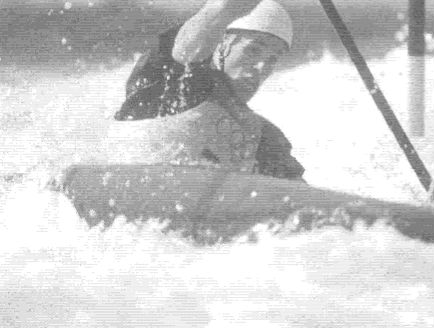
"Every Crushing Stroke" is a classic (book) about performance kayaking written by three-time World Cup Champion Scott Shipley and published in January 2002. "The Olympic Revolution" is the first chapter of the book and gives an interesting image of canoe slalom in the eighties and nineties. In the coming weeks Sportscene will re-publish extracts. The book has become a collectors item but can still be bought on Amazon. Below extract number 11. Previously published extracts:
|
Coming of Age Part IV
Scott Shipley, 2002 - Rich, Brian and I worked with Mike Druce and Jean-Michele Prono on occasion, but probably did 98% of our training without a coach. Instead of being criticized by a coach we became very critical of each other’s paddling. This is a rare trait among competitive training groups since constructive criticism does not mix well with elite-level egos. We, however, were able to put out our pride aside and thus thrived on each other’s advice. Each time one or the other of us would win a particular course we would decide between us why that was. It was like having three top-ten in the world coaches at the same workout.
We were also very competitive. I cannot remember a single non-competitive workout between the three of us. It is common now to be in a workout where people will suggest that this endurance set was going to be a “cruise". This was never once the case in our group. If Rich, Brian, or I were on the water we were on it to win, end of story. The idea was laughable to us at the time. We were competitive in every way, if one of us designed a hard course, the other would design a harder one. By the end of some workouts we would be doing moves that often unimaginable at the beginning. If we had a technique workout we’d strive to have the best technique. If we had a sprint workout we'd launch ourselves out at fullpace every single run, and in the case of an endurance workout, particularly with Rich, we'd puke up lung before we gave in. In short, if you lined up at a starting line with Rich, Brian, or I it was a race and we were going to try and beat you. If you wanted to go for a cruise, do it on your own time.
Lastly we were innovative and constantly seeking new ways to paddle faster. The one lesson we had learned well after failing at our first World Cup was that we didn't yet know how to beat these Europeans. The thirst for this knowledge became our crusade and we hired anyone and everyone to coach us for little mini-camps around the world. We also began to experiment with our regimented training plan to try and train the skills like edge control and timing that seemed to define the great paddlers. We had some workouts where we paddled more than half the workout as a C-1, others where we tried to take as few a number of strokes as possible. We took the disadvantage of only having a coach part-time and thrived on it. Every time we learned something new we’d take it back to the group and pick it apart until we had mastered it.
The real thread that ran through all of our training was responsibility. We took responsibility for ourselves in a way that is difficult to manage in a coached environment. Coached athletes often leave it up to their coach to decide which skills to learn, when and how hard to train, and most of all to evaluate their performance. We took responsibility for these things ourselves and thus had the most demanding coach possible. No coach could, in good conscience, have asked their athletes to go through the things we went through those years. We were fanatics beyond what a reasonable person can imagine.
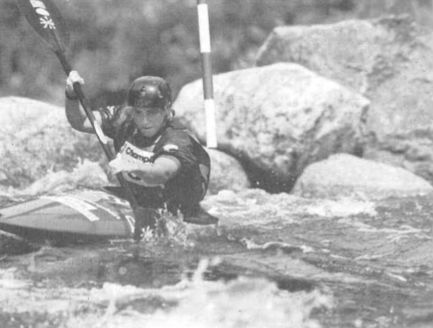 We were fanatics chasing a single carrot on a single sock. Our objective was the Barcelona Olympics and our providing grounds were the 1992 U.s. Olympic Team trials appropriately held on the Savage River. The countdown to the trials had begun long before we heard the ticking of the clock but as the date drew near not a single moment of time's passing went unnoticed.
There are many in this world who consider themselves athletes. Across America these "athletes" test themselves weekly on the soccer and football fields of our high schools and colleges. They claim to have tested their mettle in homecoming victories and regional championships but they have only scraped the surface of our world. Win or lose they will miss not a moment of their daily lives. After the game they will continue on with school or their jobs and leave their homes each morning reassured by the well-trod path they follow. Only their pride was on the line.
Not so in the brotherhood of the would-be Olympian. We set aside our school and drained our bank accounts. There is no pressure quite so palpable as that which comes from investing your entire being one single event. Imagine taking everything you ever owned into a stadium filled with people you never met. Imagine standing on a pile of your worldly goods and challenging that crowd to a test. Imagine offering everything you own to the person there who could beat you. Still you have only scratched the surface of what we stood to lose at those Olympic trials.
The pressure builds slowly throughout the year. At first it is embodied as stress. In the late fall and early winter I began to worry that my competitors were training harder or better than I was. I would constantly redouble my efforts during workouts to make sure no one could outdo my training. Later it becomes a worry, the late winter and early spring were filled with worry. Every bad workout or lost competition would leave me sleepless as I tossed and turned over my uncertain future. Finally, by spring it had become fear. I was afraid of missing that team and that fear left my training partners and I constantly on edge. It was common to see one of us break out in a tantrum because of one bad run through a training course. The team trials are a make or break competition-a loss here is the end of the road for so many who had made the claim of "Olympic Hopeful".
Next: 'The 1992 Olympics'
Editor: Jan Homolka