
 M. DAWSON
 J. CLARKE
 M. SMOLEN
 E. FER
 C. KUHNLE
 M. CHOURRAUT
 M. BENUS
 F. ANTON
 L. BOZIC
 K. HOSKOVA
 J. FOX
 BREZINSKI/BREZINSKI

 A. PETERS
 V. KHUDZENKA
 E. MEDVECKZKY
 GRIJIC/NOVAKOVIC
 L. QIANG
 M. DE JONGE
 R. POULSEN
 A. CHERVOVA
 S. TARNOVSCHI

 J. MOCKE
 E. LEVEMYR
 S. RAFAEL
 H. TAKAKU

 M. GRAZIANI
 J. EGAN
 N. LJUBEK
 MINDE/HAMAR
 PINTA/MOZZICAFI
 S. LAMMLER
 A. BUSLAIEVA
 M. WEGMAN
 S. REINOSO
Every Crushing Stroke - The Olympic Revolution, Part VI
|
"Every Crushing Stroke" is a classic (book) about performance kayaking written by three-time World Cup Champion Scott Shipley and published in January 2002. "The Olympic Revolution" is the first chapter of the book and gives an interesting image of canoe slalom in the eighties and nineties. In the coming weeks Sportscene will re-publish extracts. The book has become a collectors item but can still be bought on Amazon. Below extract number 6. Previously published extracts:
|
The Junior Worlds part I
Scott Shipley, 2002 - I had not been able to race the Junior Worlds in 1986 because it would have been too expensive to send both Paul and I to Europe in the same year. Paul was older and this was his only shot at that race. He finished a respectable thirteenth. Like all of our American C-ls he was extremely quick-fast enough for third-but had fallen victim to gate penalties on the day of the race. I had been crushed to have been left behind while all of my rivals raced Europeans that summer. I was in agony all summer knowing that I was spinning my wheels in my hometown of Poulsbo while people I could beat were racing in Germany and Austria. The idea that finances had kept me off a team I deserved to be on burned in the back of my head as I stormed through my workouts that summer.
The end result of being left home was that the US kayaks came home to the Junior Nationals confident of their abilities while I left Poulsbo hungry for that title. In fact, our team had been so confident that year that as I paddled into the starting gate a team boat asked for an extra minute so he wouldn't “catch me"! I couldn't believe my ears! An extra minute is reserved solely for the whitewater handicapped-those who can't manage to be swept downriver at an equitable enough pace to avoid being caught. My resolve to dominate that race was redoubled right there in the starting gate. I have won a few National titles in my life, but none were quite so satisfying as the first one, the title 1 won with an extra minute gap behind me.
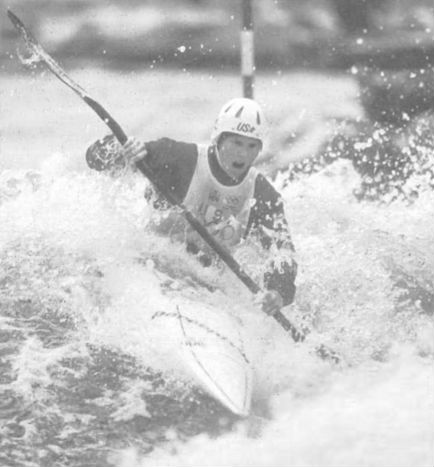 An entire summer of wishing I was in Europe almost made that first National Championship a moot point. Before I ever took a single stroke in that race 1 was already dreaming of bigger things. The Junior Worlds had become the next target on my "hit list".
Winning the Junior Worlds was a whole different class of race however. Try to think of it this way: Pick any sport you like and imagine the best guy at your high school, then imagine the best guy in your region, then the best guy in your state. Take it a step further and imagine the best of the state champions: the National champion. The Junior Worlds is the collection of these elite athletes from around the world.
The Junior World Champion is the best of these best. I was fifteen when I won my first National title, that same night I focused my sights on this new achievement. I would be Junior World Champion.
I have always had an overabundance of confidence. Growing up I was cocky beyond what most people can even imagine. I had come to my first National Championships secure in the knowledge that I would leave a champion, despite being 12 years old. In fact, I'm almost embarrassed to admit that I was sure I would win the open class! This was an attribute that a U.S. team coach first identified as "Necessary Arrogance". This was supreme confidence and it was a mindset that had its advantages. While others would write off early races as being a learning experience I would compete with a singular frame of mind. When I leave the starting gate I'm not out to learn anything. Since my first start in my first race I have always left the starting gate with a single objective-l want to beat everybody!
Once I set my goal of being the best in the world I was stunned to find that no one but myself believed I could actually win that title! The Slovenians had finished first, second and fourth in the previous Junior Worlds and the idea that they, along with the other Europeans, were unbeatable had become entrenched in our Junior program. At this point no American men's kayaker had ever stood on an awards platform at a World Championship and many had come to believe that the Europeans were invincible. Some naysayers actually laughed when I told them I wanted to win this race. One of my own team coaches actually told me I couldn't win!
The Junior Worlds are a tough race to forecast. The race only takes place every second year. By the time the next Junior Worlds would come around the field would change almost entirely. Quite often the fastest boats at one Junior Worlds would outgrow their positions before the next. Despite the rotating team roster the Europeans had consistently good results. These results came from extremely well run junior programs. Year after year they would create fast juniors because they had great coaches, great facilities and great competition. On a team level this was an intimidating prospect on a personal level it meant very little. As I said before, I was never lacking in self-confidence. I reasoned that there was the same amount of training time in a day over there as we had in America.
At the age of 16 I finally managed to qualify for the National Junior team. In a stroke of luck I also made the senior team at the those same selections. This allowed me to compete at the Pre-World Championships on the Savage River in Maryland - an event that served as valuable preparation for the Junior Worlds.
Editor: Jan Homolka