
 M. DAWSON
 J. CLARKE
 M. SMOLEN
 E. FER
 C. KUHNLE
 M. CHOURRAUT
 M. BENUS
 F. ANTON
 L. BOZIC
 K. HOSKOVA
 J. FOX
 BREZINSKI/BREZINSKI
 A. PETERS
 V. KHUDZENKA
 E. MEDVECKZKY
 GRIJIC/NOVAKOVIC
 L. QIANG
 M. DE JONGE
 R. POULSEN
 A. CHERVOVA
 S. TARNOVSCHI

 J. MOCKE
 E. LEVEMYR
 S. RAFAEL
 H. TAKAKU

 M. GRAZIANI
 J. EGAN
 N. LJUBEK
 MINDE/HAMAR
 PINTA/MOZZICAFI
 S. LAMMLER
 A. BUSLAIEVA
 M. WEGMAN
 S. REINOSO
Every Crushing Stroke - The Olympic Revolution, Part II
|
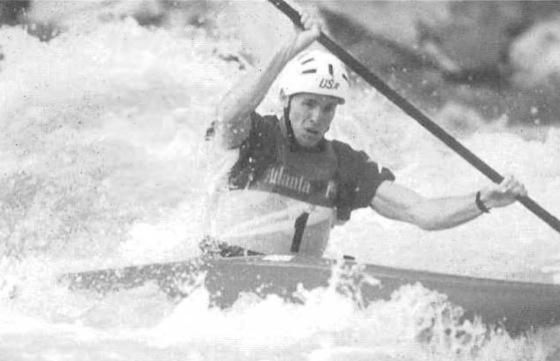
"Every Crushing Stroke" is a classic (book) about performance kayaking written by three-time World Cup Champion Scott Shipley and published in January 2002. "The Olympic Revolution" is the first chapter of the book and gives an interesting image of canoe slalom in the eighties and nineties. In the coming weeks Sportscene will re-publish extracts. The book has become a collectors item but can still be bought on Amazon. Below extract number 2. For the first extract click here. |
Getting Started II (Getting Started I)
Scott Shipley, 2002 - Our first kayak was a monstrous boat, still the biggest kayak I've ever owned, and this became our sidecar. As it turned out this couldn't have been a better arrangement. My brother and I, who normally argued and fought over everything, would race to be the opposite in this case. Paul desperately wanted to paddle canoe with my dad and I, more desperately than anything, wanted to be in that kayak.
Our training situation was a bit awkward at the time. We grew up by the water on the shores of Puget Sound and had the scope of the Pacific Ocean at our disposal. This meant we could paddle as much as we wanted to. Unfortunately, the Pacific, even in the narrowest of its local inlets, was too wide for gate wires and we were limited to a single gate hung from a local pier. Our closest training course was more than an hour's drive away. Instead we would snake in and out of the different piers, do sprints from here to there and back again, fill the boats with water and pretend we could do the same monstrous pivots that we had heard Lugbill and Hearn were doing. It was the sort of training site that would either become completely stifling, or, as was later to be the case, a spawning ground for innovation.
Essentially our training was one of two things. Either we were sprinting around the sound in some form or another, or else we were running rivers. River running was the thing we did that probably had the most effect on our abilities later. My dad was big on finding adventures so we were constantly in search of new experiences. We ran all sorts of rivers, everything from huge big water to tiny tributaries. We'd go to the ocean and surf waves or we'd lower our-selves down seventy feet of rope on muddy cliffs so that we could run Pilchuck creek in flood. Every weekend was a new adventure often in a new place. In today's slalom world future Olympians are weaned on flatwater courses and coached gate technique workouts. My brother Paul and I cut our teeth two hundred feet deep in the snowy Green River gorge surfing four foot curling waves while we shivered in our wool underwear and homemade jackets.
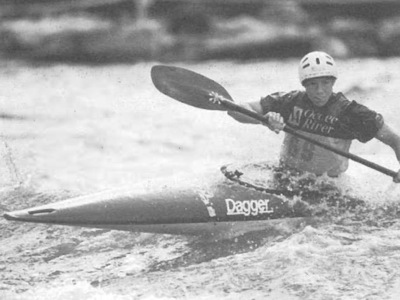 [Pictured left: Scottie Smith, photo by Chris Smith] Although we spent most of our time running rivers, my brother and I were entranced with slalom racing. My father had raced for the U.S. National team in the sixties and we begged him to take us to races. This was not an easy task in the Northwest at the time. Our sport had a small following and a limited number of races every year. The entire area boasted only a single permanent flatwater training site. In spite of our lack of slalom courses we thought of ourselves as nothing less than slalom racers. For fifteen years not a single race happened within a three state radius of our home without the Shipleys being there. I had been involved in many sports before we began paddling but quit those teams rather than waste more time on an endeavor that got in the way of slalom. Both my brother and I latched on to paddling with fervor from the first strokes we took. Neither one of us ever stopped to decide if we wanted to dedicated ourselves to this sport; it was something we just knew from the start.
We had a fairly active group of slalom athletes in our area at the time. Five to ten of us would meet Wednesday nights in Seattle for slalom workouts on the Northwest's lone flatwater slalom course.
Occasionally we would set up a moving water course on the Cedar river and make the hour and a half trek to train there twice a week. We had no coach at the time but I can rattle off a long list of people who, in the absence of a trainer, took the place of a coach for us. The entire training group fed each other training groups I’ve ever been a part of despite the fact so few of us had any intention of taking our pursuit of the sport out of the Northwest.
Much of my early paddling technique came from my father, but I really started to make jumps in my paddling when a local racer, John Day, began working with me during our Wednesday night gate sessions. John was, at the time, one of the top ten paddlers in the United States. He had a long slow stroke rate and was masterful at gliding through gates and using whitewater to make moves easier. I adopted all of these attributes and made them my own. In the Northwest John, along with his brother Mike - who was often back east racing - were the top of the heap. When they began a run all of us would rush down the course to see as much of their paddling as possible. They were the best of their time. Since they traveled the world to bigger paddling events they were also our only source of new techniques and equipment.
When I was little I would target people in my training. At the end of each season I would pick someone I wanted to better by the next year and then spend the winter training to beat him. At first, this meant beating the local masters champion, then the fastest lady in our club until eventually I was chasing my mentors themselves. I grew up with an overwhelming desire to compete, to be faster, to beat people. Every workout and every race I was focused on attack, attack, attack. If I was slower then my target, I would dig deeper to paddle better and faster on my next effort. The great lesson I took from these early years was the respect we all shared despite how competitive these workouts and races were. At the tick of a watch we were desperately racing to beat our training partners yet moments later, when the watch was off, we would help each other. We were teammates in the truest sense.
Editor: Jan Homolka