
 M. DAWSON
 J. CLARKE
 M. SMOLEN
 E. FER
 C. KUHNLE
 M. CHOURRAUT
 M. BENUS
 F. ANTON
 L. BOZIC
 K. HOSKOVA
 J. FOX
 BREZINSKI/BREZINSKI

 A. PETERS
 V. KHUDZENKA
 E. MEDVECKZKY
 GRIJIC/NOVAKOVIC
 L. QIANG
 M. DE JONGE
 R. POULSEN
 A. CHERVOVA
 S. TARNOVSCHI

 J. MOCKE
 E. LEVEMYR
 S. RAFAEL
 H. TAKAKU

 M. GRAZIANI
 J. EGAN
 N. LJUBEK
 MINDE/HAMAR
 PINTA/MOZZICAFI
 S. LAMMLER
 A. BUSLAIEVA
 M. WEGMAN
 S. REINOSO
Every Crushing Stroke - The Olympic Revolution, Part X
Interview with David Ford a few years ago.
|
"Every Crushing Stroke" is a classic (book) about performance kayaking written by three-time World Cup Champion Scott Shipley and published in January 2002. "The Olympic Revolution" is the first chapter of the book and gives an interesting image of canoe slalom in the eighties and nineties. In the coming weeks Sportscene will re-publish extracts. The book has become a collectors item but can still be bought on Amazon. Below extract number 10. Previously published extracts:
|
Coming of Age Part III
Scott Shipley, 2002 - Toughness became a mantra among us. Where we could have worn dry suits and pogies to keep warm we went barehanded and wore simple nylon paddle-jackets. Year round we arrived at our workouts barefoot and wearing shorts. When the weather turned especially wicked and cold, a time when other paddlers in other places might choose to stay inside in lieu of a whitewater workout, we resolutely arrived fifteen-minutes early to allow extra time to de-ice the wires as we adjusted the gates. On one especially memorable day Rich and I returned to find my car entrapped in a wall of ice thrown up by a passing snowplow. Never one to tarry, Rich immediately jumped to the task of digging a passage through the snow mound with his kayak paddle. For five minutes we worked to dig a sufficient gap for my car to exit the parking lot. We stood barefoot in the snow throughout the entire task despite being less than ten feet from our dry clothes and snow boots.
Our toughness had a profound effect on our training. Despite the harsh Canadian winters our training totals were completely unaffected by the weather. If our training schedule said train, we trained; the weather had nothing to do with it. Our mindset became one of our biggest strengths. No amount of effort was too much to ask if it might pry precious milliseconds off our times. We were of singular mind and indefatigable in our efforts-we had become the purest form of fanatics.
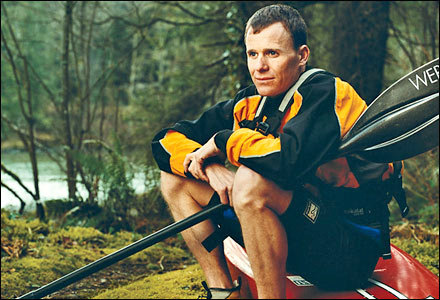 We pushed the edge of the envelope in every way possible. This is especially true if you look at the whitewater we were running. The three of us, Brian Brown in particular, were making big and steep whitewater a regular part of our weekly training. The Chilliwack River will flood to biblical levels on a monthly basis throughout the winter. These floods would obliterate our slalom course, flood all of our eddys and make organized training an impossibility. For many this meant a week spent in the flat water gates but for us it was a play day. We would race to the upper-Chilliwack canyon the next day and spend four hours on big water class four with our slalom boats. In the three years I trained with that group we consistently ran the biggest and most intimidating rivers we could find on a regular basis. In fact, we often would go out of our way to find and excuse to skip the gate training and go river running.
For those few years we were some of the best extreme boaters in the world. We were running any and everything with a confidence that soon began to outweigh our skills and our equipment. We ran flooded raging rivers and tight, steep, waterfall-laden creeks all in our eighteen-pound slalom kayaks. We knew we were on the raged edge because the farther we went the more we began to falter. I had almost drowned on a tree in the upper canyon, Brian had pinned so badly that one of us had to swim out to rescue him, and Rich had one of the ugliest pins any of us had ever seen while playing in a C-1 at our training site. Yet still the shell of our invincibility remained un-cracked, for now.
In lieu of a flood we would often wake up early for a “Skook-Day”-a trip to Skookumchuck narrows. This is a tidal riff north of Vancouver, B.C. that creates the greatest surfing wave in the world. I read once that the D.C. C-1 claimed that surfing the big wave at "O-deck" on the Potomac River of Maryland was the secret to their success. The Skook was O-deck on a heavy dose of steroids and most days we had it all to ourselves. The wave is easily thirty-five feet across and can build up to the heights approaching eight to ten before it finally collapses into a monstrous hole. The wave was big enough that two people in slalom boats could swap sides while surfing the wave! This was slalom training at its best.
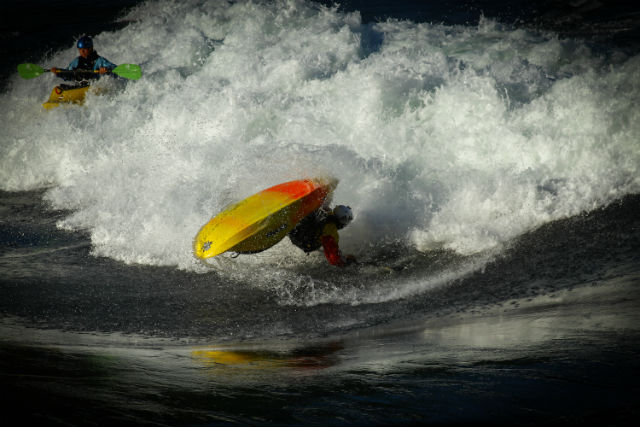 The three of us, with several or our Canadian training partners, would make regular pilgrimages there. It was the most fun any of us ever had in a boat. We surfed for hour after hour and laughed the entire time. It was crazy, fast, and challenging and most of all it was harmless. I often think back to those early days and the desperate attempts we were making to become champions. We went through a lot together, some good times and some bad. It is hard to think of any better memories than the those at the Skook with Brian, Rich, and the Canadians.
I think it must be hard to believe how poor we were in those days. We lacked coaches, we lacked funding, we didn't even have the money for proper housing. The first winter I spent in Chilliwack I lived on the $1200 the USOC had given me for the top Junior the previous year. I lived in a broken down shoddy old tree house for $30 a month. I had no heat, no lights, and no running water. Top Canadian paddler Larry Norman was my neighbor and we shared a port-a-potty for a bathroom and cooked in an outdoor kitchen throughout the Canadian winter.
In many ways I began to feel like the deep-sea life I had studied in my high-school biology class. There is an entire ecosystem of sea life that is able to live far beneath the sea. At these depths, they are out of reach of the sun's energy. Instead they exist on thermal energy from geothermal vents on the Ocean floor. This was our situation in Chilliwack. We had no viable conventional heat source. Our only real source of heat a shower/bath facility installed for summer rafters to bathe in after their trip down the river. This became our thermal vent and crowded it for every joule of energy available.
At night we’d hang our wet gear on the rail with hopes it would dry by morning. Most nights the gear would freeze before it had a chance to drip dry. Even before we'd finished dinners the gear was frozen stiff beyond any hope of being wearable. In the morning we'd fill a tub with hot water and drop the clothes in to thaw before we climbed in after them to get dressed. More often then not we'd do our workout and rush back to that same tub, our only real source of thaw out our frozen hands and feet as well as our clothes.
In the the larger picture, despite the hardships, this was good training and it paid off with good results. In 1991 Rich was third in the Over-all World Cup and both David Ford and I in the top ten. By the next year Rich, Dave, and I had each won a World Cup race. We had a great training group and once again, as it had with the D.C. canoes, this dynamic was producing medals. We had taken North American kayaks and put them on the medals stand for the first time ever. I think there were few things in particular that directly led to our success.
Editor: Jan Homolka