
 M. DAWSON
 J. CLARKE
 M. SMOLEN
 E. FER
 C. KUHNLE
 M. CHOURRAUT
 M. BENUS
 F. ANTON
 L. BOZIC
 K. HOSKOVA
 J. FOX
 BREZINSKI/BREZINSKI

 A. PETERS
 V. KHUDZENKA
 E. MEDVECKZKY
 GRIJIC/NOVAKOVIC
 L. QIANG
 M. DE JONGE
 R. POULSEN
 A. CHERVOVA
 S. TARNOVSCHI

 J. MOCKE
 E. LEVEMYR
 S. RAFAEL
 H. TAKAKU

 M. GRAZIANI
 J. EGAN
 N. LJUBEK
 MINDE/HAMAR
 PINTA/MOZZICAFI
 S. LAMMLER
 A. BUSLAIEVA
 M. WEGMAN
 S. REINOSO
Every Crushing Stroke - The Olympic Revolution, Part VIII
Jon Lugbill at the 1989 Worlds. Also click here to watch more C1 runs by Dale Briggs.
|
"Every Crushing Stroke" is a classic (book) about performance kayaking written by three-time World Cup Champion Scott Shipley and published in January 2002. "The Olympic Revolution" is the first chapter of the book and gives an interesting image of canoe slalom in the eighties and nineties. In the coming weeks Sportscene will re-publish extracts. The book has become a collectors item but can still be bought on Amazon. Below extract number 8. Previously published extracts:
|
Coming of Age Part I
Scott Shipley, 2002 - In 1989 our sport came of age in America. These were the glory days of U.S. slalom. It was the year we hosted a World Championship on the Savage river in Maryland and then categorically dominated the event. This was the first time ever we had attracted a large crowd and then captivated them with this sport. The banks of the Savage River played host to thirty thousand people and not one of them, myself included could bear to sit as Jon Lugbilll charged by on his way to a twelve-second victory! It was stunning! Never before or since have I seen anyone attack a race run like that. It was inspiring and breathtaking at the same time. It was truly stunning to watch one of the greatest runs of all time.
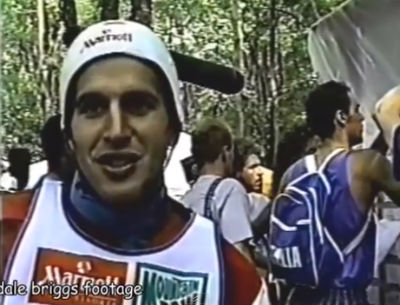 Perhaps my most vivid memory from that event was the team run. In the starting gate Jon Lugbilll lined up behind Jed Prentice and Davey Hearn. Jon had won this event, Davey was second and Jed had finished in Fourth, milliseconds out of a medal. Even before this race Jon and Davey had become demigods in our sport. Over a ten-year period they were virtually unbeaten and Jed, the 1986 Junior World Champion, was cast as their successor. What we knew at the time was that the prowess of these paddlers was of mythical proportions. What none of us could possibly know yet was that this was their swan song. Within two years the Europeans would catch our canoes and they would no longer dominate this field as they had for the past ten years. That was in the time to come, this was 1989 and it was beyond belief that they could lose-for now the river was theirs. For this team run they had decided to send Jon first. For 10 years Jon and Davey had led a third boat to the Gold Medal podium in this event. The expectation was that this year would be no different.
The Savage river sits in the heart of the Blue Ridge mountains, so named for the thick low mist that often coats its valleys. That mist was especially heavy on the Savage that day and the entire race had been plagued by a thick fog low to the river. The fog was so thick that at first we saw nothing. This was a two hundred second long course and all we could sense were the cheers of the crowd as the gang drew steadily nearer. Those cheers became a roar around us even as we squinted into the fog for any sign.
My most acute memory of that great day was a fist. The first thing to break the low-lying fog was Jon's fist. It was his top hand protruding above the mist and it hammered angrily into and out of the fog with each pounding stroke. Even before we could make out the rest of their bodies we could make out the three fists of their top hands as they pumped furiously through the mist. This was a three-man team on a Lugbill-like charge down the course! Jon, Davey, and Jed each indistinguishable from the next, each of them champions in their own right. Finally the three of them surged out of the fog on full speed sprint, deftly wove through the three or four gates within view, and then disappeared into the fog on their way down the course. With their passing so too the peak of their era. They belonged to another time; they were champions of the old school. With the finish of that day’s race began a new era. No longer were we concerned with World Championship medals, all eyes focused now on Barcelona and its Olympic Games. We had only three years until the opening ceremonies.
 For the U.S. team, 1989 was a tremendously successful year. For me it was my biggest failure. 1989 was my last year as a junior but I had wanted more than anything to race as an adult in those World Championships. It was bitterly disappointing to finish tenth in those selection races after having made the team the year before. Since I had won the Junior Worlds people begun had to speak to me as if it were now my destiny to race in the 1992 Olympics. All of the kids in my age group thought the same way. For some reason we had all assumed that our great team of 1989 would step aside and make way for the next. Our kayaks had been very successful at those Savage Worlds and I realized it was insane to believe they wouldn't fight tooth and nail for an Olympic berth. To be an Olympian in 1992 meant I had just three years to beat every American kayak, to be an Olympic Champion would likely take more than that.
On the other hand those Worlds inspired me. My arrogance had got the best of me once again and I focused my sights on Olympic Gold. I launched myself into my training like I never had before. For once I wasn't alone in this. My once remote training site in Canada became a Mecca for the top kayaks on the continent. Rich Weiss and Brian Brown from the U.S. moved there. Top Canadian performers David Ford and Patrice Gagnon also became residents.
Mostly by coincidence we had become the greatest collection of North American kayaks ever put together. We trained in two separate groups for the bulk of our workouts, the Canadians in one group and us Americans in the other, but got two or three times a week for our competitive workouts.
For ten years now American kayaks had been trying to match the dominating performances of our canoes. Many Americans paddled boats of similar design to the canoes, they trained the same way the canoes did, and they fashioned their technique off of the tight pivots our C-1s were making. This was a frustrating time for our kayaks. Many people spent their entire careers doing fourteen workouts a week and never knowing why it was that they couldn’t catch the Europeans. By 1990 we were desperate to try something new and hired French coach Jean-Michele Prono to show us exactly what it was the Europeans were doing that made them so successful.
Read 'Coming of Age' Part II...
Editor: Jan Homolka