
 M. DAWSON
 J. CLARKE
 M. SMOLEN
 E. FER
 C. KUHNLE
 M. CHOURRAUT
 M. BENUS
 F. ANTON
 L. BOZIC
 K. HOSKOVA
 J. FOX
 BREZINSKI/BREZINSKI

 A. PETERS
 V. KHUDZENKA
 E. MEDVECKZKY
 GRIJIC/NOVAKOVIC
 L. QIANG
 M. DE JONGE
 R. POULSEN
 A. CHERVOVA
 S. TARNOVSCHI

 J. MOCKE
 E. LEVEMYR
 S. RAFAEL
 H. TAKAKU

 M. GRAZIANI
 J. EGAN
 N. LJUBEK
 MINDE/HAMAR
 PINTA/MOZZICAFI
 S. LAMMLER
 A. BUSLAIEVA
 M. WEGMAN
 S. REINOSO
Every Crushing Stroke - The Olympic Revolution, Part I
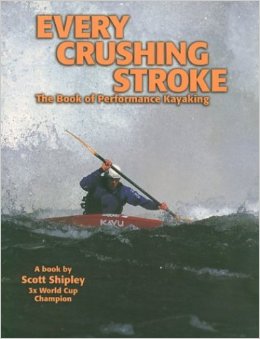
| "Every Crushing Stroke" is a classic (book) about performance kayaking written by three-time World Cup Champion Scott Shipley and published in January 2002. "The Olympic Revolution" is the first chapter of the book and gives an interesting image of canoe slalom in the eighties and nineties. In the coming weeks Sportscene will re-publish extracts. The book has become a collectors item but can still be bought on Amazon. |
Before you claim that you are 'committed to slalom' I want you to picture what went in to your last breakfast of ham and eggs. The chicken was merely involved in creating that breakfast, the pig... the pig was committed
- Lecky Hailer, Two-time Olympian
Getting Started I
Scott Shipley, 2002 - It's hard to explain in today's slalom terms, to people who know slalom as an Olympic sport, what our sport was like only ten years ago. We who were there are now "old- school"-we were kayakers before people knew what kayakers were. So much about our sport changed when we became an Olympic event. To be a full-time kayaker ten years ago put you one rung above a longhaired skateboarding teenager on the scale of social grace.
Times have changed. We are no longer the futureless renegade drop-outs, Kayak- parents no longer describe their sons and daughters as people who are "Trying to find themselves" or "Taking a break from their goals". No, now we are Olympians. Put any eight to twenty-nine year old in a kayak and he's no longer learning to kayak, he's an "Olympic Hopeful." Gone are the days when we stood in the shadow of more respectable sports. Kayakers now adorn the pages of Sports Illustrated and are broadcast daily into our homes in an attempt to sell more cars and computers.
We have yet to become a "rich" sport yet we are wealthy beyond the wildest dreams of our recent predecessors - an evolution that has meant more coaching, more support, and more sponsorship. The Olympic family has welcomed us into their fold, and in so doing has forever changed the face of slalom in America.
In 1980 our sport was different. Sport Utility Vehicles had not yet replaced the rusted v.w. vans and ratty old station wagons that had formerly transported our sport. Trips to Europe were frequently paid for with re-allocated student loans or odd jobs worked in D.C. neighborhoods. I can remember Jed Prentice, Junior World C-l champion, driving to a four-day training camp with a jar of peanut butter, a jar of jelly, three cans of powdered carbo-drink, and some vitamin supplements. We were on borrowed time because we had neither the money nor the credibility to put aside our lives for very long. To commit yourself to a year of full-time training in our sport was to betray any hopes your family and friends had that you'd become a success at life. I hear people talk about being committed kayaking now and think of them as bungee jumpers leaping off of a bridge while strapped to rubber bands carefully calibrated to cushion their landings. Whether they make it or not they are golden children to their families and friends. Such a grand objective! The champions of yesterday were the base- jumpers who made a leap of faith before they unfurled their chutes with their talent and dedication; there were no soft landings for the weak-hearted in that day. Make or miss the team and you were still likely to hit rock bottom. We were the black sheep; we were the ones who had put aside our goals to go paddling.
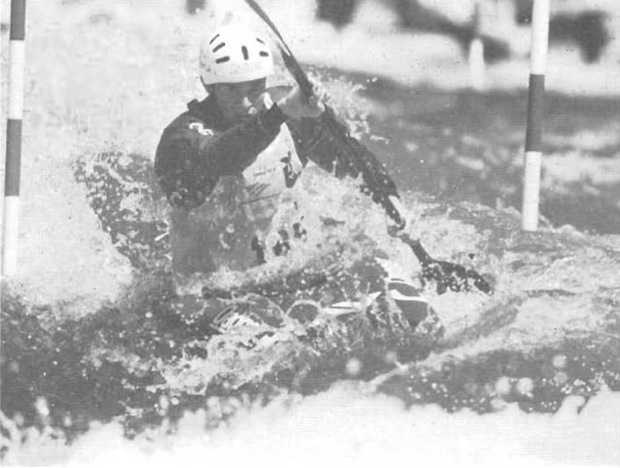
 In 1980 names like Jon Lugbill and David and Cathy Hearn raced across our sport like wildfire. America had won medals! Even before I knew I was missing a hero in this sport we had made to order ones flashing across our newly invented VCRs. Lugbill was the consummate champion-aggressive and bold all the way to the finish, Davey the technician-precise and calculating. In Cathy we saw our first look at an uber-woman who would sit at the peak of our sport for a generation. We watched these paddlers in the one spotlight available at the time, in a movie called "Fast and Clean." It was an all at once thriller, documentary and infomercial for the sport of kayaking and the deeds of these great paddlers. I grew up watching and re-watching that film and dreaming of attaining or surpassing their deeds. Not once in all that time did I crave the riche of a pro athlete or the recognition of an Olympian. I wanted to be like my heroes. I wanted to drive to Jonquiere in my green Cathy Hearn style Pinto and I wanted to launch myself out of the starting gate like Austrian Norbert Sattler. I wanted to be the fastest kayaker in the World.
My father had learned to paddle from his father-presumably his father could say the same thing about my great-grandfather. There seems to be a Shipley way to learn to paddle, passed on from generation to generation and unchanged by any improvements in technology. I took my Arst strokes in the same aluminum canoe that my father had paddled with his father. We used ancient paddles carved from a single piece of wood and sewed our own paddling gear. Our paddle jackets were last year's windbreakers with neoprene cuffs sewed on the arms. Our early spraydecks were sewn by hand using the same patterns my grandmother had created for some of the first fiberglass boats ever to be paddled in this country.
River running, in my father's time, was done with local clubs. It is an affiliation you still see in Europe although it has become rare in the U.S. This meant that my earliest experiences in paddling were far from the nearest gate course. Instead we spent our weekends exploring different northwest rivers in our big Canadian-style canoe. My father craved adventure in the truest and purest form, which had the side effect of making these weekend excursions wet, cold, and miserable. He believed in roughing it and learning the old way and our weekend excursions were no exception. We shivered through weekend after weekend in our leaky age-old tent. Our homemade gear steamed in a ring around a blazing Are while we feasted on the food my father never learned how to cook.
We ran all these rivers as a family team in our great canoe. My Dad was in the back and either my brother or I in the front, the remainder in the middle. We took turns reading the rivers and deciding which route the family would take down the next set of rapids. Both my brother and I argued over who would sit in the bow and which eddies we would catch or miss. As you can imagine it wasn't long before we outgrew this arrangement and needed another boat to keep us separated.
Editor: Jan Homolka