
 M. DAWSON
 J. CLARKE
 M. SMOLEN
 E. FER
 C. KUHNLE
 M. CHOURRAUT
 M. BENUS
 F. ANTON
 L. BOZIC
 K. HOSKOVA
 J. FOX
 BREZINSKI/BREZINSKI

 A. PETERS
 V. KHUDZENKA
 E. MEDVECKZKY
 GRIJIC/NOVAKOVIC
 L. QIANG
 M. DE JONGE
 R. POULSEN
 A. CHERVOVA
 S. TARNOVSCHI

 J. MOCKE
 E. LEVEMYR
 S. RAFAEL
 H. TAKAKU

 M. GRAZIANI
 J. EGAN
 N. LJUBEK
 MINDE/HAMAR
 PINTA/MOZZICAFI
 S. LAMMLER
 A. BUSLAIEVA
 M. WEGMAN
 S. REINOSO
Every Crushing Stroke - The Olympic Revolution, Part IV
|
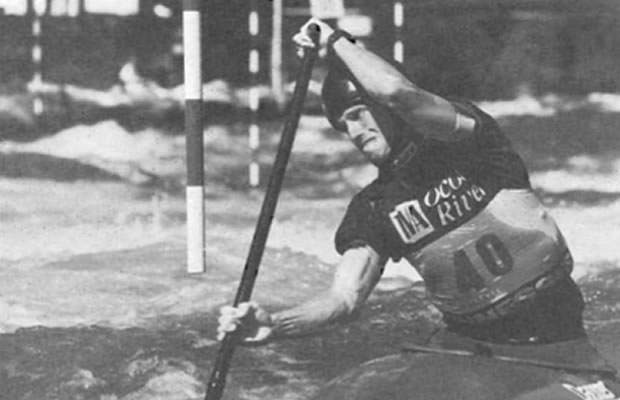
"Every Crushing Stroke" is a classic (book) about performance kayaking written by three-time World Cup Champion Scott Shipley and published in January 2002. "The Olympic Revolution" is the first chapter of the book and gives an interesting image of canoe slalom in the eighties and nineties. In the coming weeks Sportscene will re-publish extracts. The book has become a collectors item but can still be bought on Amazon. Below extract number 4. Previously published extracts:
|
The Junior Circuit I
Scott Shipley, 2002 - Two big things happened in 1986 that changed the way things were heading. My brother Paul got his driver’s license and we discovered the Canadian National team training site in Chilliwack, British Columbia-about four hours from our house.
Chilliwack is an end-of-the-road town in one of the rainiest parts of the entire Northwest. Make no mistake about this place, it is cold, constantly cloudy, and the winter days are barely long enough to allow workouts. Canadian team member Larry Norman summed up the situation best when he said: ”The weather here is easy to predict, if you can see the mountains it's going to rain , if you can't see the mountains… it is raining”.
It was a dark, dreary, and depressing place to train. If the clouds do clear you can see that the river cuts through the harsh Canadian wilderness. The sharp snow-covered crags of the Canadian Coastal range surround the river. More often than we awoke to find those mountains cloaked in a heavy layer of clouds that left the valley dark and shaded. Our view would reach only a few hundred feet up the valley walls and merely revealed that the snow line was closer that morning than we had hoped. Instead of awakening to a stunning vista of our mountainous surroundings we were often as not surrounded in mist and rain and leaves rotting beneath a thin layer of snow.
This was our gymnasium, nothing less and nothing more. We lacked any sort of conventional clubhouse or training center. We changed our clothes in the dirt beside our cars and we trained in the stadium that God gave us.
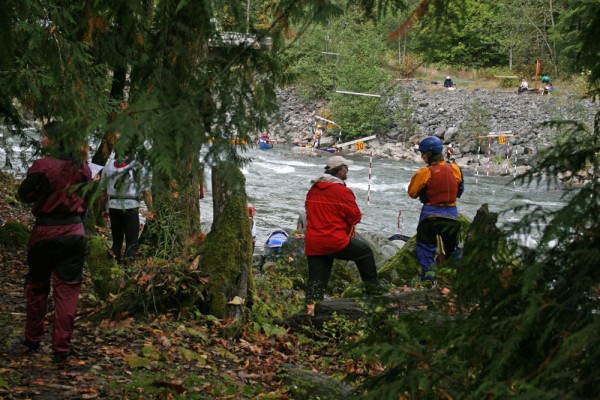
What a stadium it was though, there are few places in the world that can compare to the training site in which we paddled daily on the Chilliwack river. Tile rapid is a powerful class three to four rapid that cuts through the rugged Canadian wilderness. The river there is about 30 meters wide and littered with obstacles leaving an almost infinite number of gate combinations. The site also has three big areas of drop separated by three separate easier sections that can be easily attained by training athletes. As athletes, this gave us three completely separate training basins in which to train. In short, it is everything you could hope for in a natural training site. Day after day and week after week we could train in what was almost - except the cold and wet - ideal conditions. Our full-lengths were the equal of most World Cup courses and everything from short courses to long endurance could be done in the best of settings.
Chilliwack became a weekly destination for Paul and I and the world we paddled in began to change radically. Although I missed paddling with our old club we almost instantly switched from being active club members to being fanatical racers. The group we now paddled with were of a similar mind: train better, train smarter, and get faster. Since no one ever really wanted to live in Chilliwack our training group was mostly made up of people like us. We had homes in Seattle, Bellingham or Vancouver and we commuted to Chilliwack for the weekend's workouts. Each Saturday morning we would rally by the river at 9:00 to set a full-length course.
For the first time Paul and I had access to a full-length slalom course, like-minded training partners, and a long-term coaching relationship. To say we had a coach is true, but not in the terms people think of today. This was still the time before there were paid coaches in North America. Coaches like Bill Endicott and my coach, Eric Munshaw, were few and far between. Like the rest of us they were unpaid in any way. These people volunteered their time, paid their own expenses, and often made as many or more sacrifices than their athletes.
With 20/20 hindsight people must assume that I was the little starling favored by coaches and clubs alike as I was growing up. This was never the case. Early on I was an awkward youth and there was barely enough coaching available for even the World Class athletes in our country. Still, Eric managed the time to work with some of us on a sporadic basis. On average I would say I had two coached workouts a month from Eric and there were two big ways that he affected my paddling:
The first was that Eric was constantly holding training camps where we would work together as a group. In these camps he would hold nightly sessions where he lectured us on race-preparation, visualization, making training plans and keeping training logs. I soaked up his lessons like a sponge. He was the first one to put ideas into my head about organizing our training, making a race plan for every run-in both training and race situations, and learning to focus my technique sessions so that I improved at an astounding rate.
Suddenly my training was no longer a slap-shot collection of randomly chosen workouts. Things that I take for granted now, like our long endurance workouts in the fall and our lactic training in the spring were suddenly revealed to me. Where I had once been wandering around in the dark doing whichever workout seemed appropriate I now focused my efforts. I felt I was now learning to aim my training directly along the shortest path to World Championship medals I had begun to train efficiently.
Knowing how to train in a kayak and knowing how to paddle a kayak are entirely different things. In America, the 80's were the era of the American C-1 s and we all marched to the tune of their success. Despite Fox's many World Championship wins, the fittest of American kayaks spent their technique sessions learning the windshield-wiper pivots and sit-and-spin style that our canoes were using to dominate the Europeans. Any coach worth his salt in America preached their tune and any paddler hoping for success fell in line to follow their beat. In many ways we Americans were like so many sheep following a single shepherd.
Whether it was because he was isolated from the roar of their success or because he saw their success for what it was-domination of the canoe class- Eric shunned the American's paddling. To say Eric taught me the secrets of great kayakers would be an exaggeration. He didn't know their secrets any more than the rest of us. The truth is that no one in North America knew them at the time, no one. What Eric taught us was that paddling like a C-1 wasn't going to beat the likes of Richard Fox. We had to find a better way. We had to teach ourselves to paddle kayaks like kayaks. The second thing Eric taught us was to discover these things for ourselves.
On the water, which is to say after we had prepared for our workouts, Eric focused on two things. The first of these was that I paddle from the bow and forgo the large pivots and sit-back style of my American compatriots. "Push the bow Scotty," he'd say. ”Get off the stern and push your knees where you want the boat to go." I was young and like all youngsters I preferred my newly mastered big pivots and flashy spins. Eric favored a more toned down-keep the boat running approach to paddling. He would push us to practice doing moves off the bow. We would practice banking turns and edge control to work on keeping the boat moving through our turns.
The other thing he brought to our on the water workouts was a focus to our training. We would isolate just the thing we wanted to work on. It is common in today's world to focus on certain gate moves.
Editor: Jan Homolka, Colour photo: Ryan Bayes