
 M. DAWSON
 J. CLARKE
 M. SMOLEN
 E. FER
 C. KUHNLE
 M. CHOURRAUT
 M. BENUS
 F. ANTON
 L. BOZIC
 K. HOSKOVA
 J. FOX
 BREZINSKI/BREZINSKI

 A. PETERS
 V. KHUDZENKA
 E. MEDVECKZKY
 GRIJIC/NOVAKOVIC
 L. QIANG
 M. DE JONGE
 R. POULSEN
 A. CHERVOVA
 S. TARNOVSCHI

 J. MOCKE
 E. LEVEMYR
 S. RAFAEL
 H. TAKAKU

 M. GRAZIANI
 J. EGAN
 N. LJUBEK
 MINDE/HAMAR
 PINTA/MOZZICAFI
 S. LAMMLER
 A. BUSLAIEVA
 M. WEGMAN
 S. REINOSO
New Feature on the Nantahala River
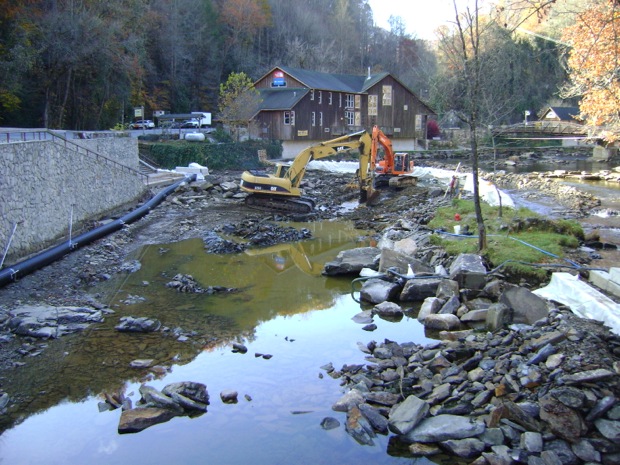
Bryson City, North Carolina is home to the Nantahala River, one of the most popular whitewater rivers in the United States. The riverbed has recently been modified in preparation for the 2013 World Championships in freestyle kayaking. Construction of a man-made feature, known as a “wave shaper”, has just been completed with the goal of creating a world-class, tunable play hole. The wave shaper is located next to the Nantahala Outdoor Center, downstream of the busy commercial raft traffic that regularly occurs during the summer months.
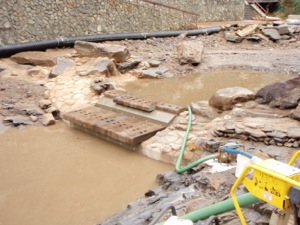
The $300,000 wave shaper design was commissioned by the Nantahala Gorge Organizing Committee, whose membership consists of representatives from several organizations, including the Swain County Tourism Development Association, USA Canoe/Kayak, Endless River Adventures and the Nantahala Outdoor Center. The committee received an economic development grant from the Golden LEAF Foundation to help fund the river improvements, and contracted with the McLaughlin Whitewater Design Group to engineer the custom wave shaper for the Nantahala. This particular wave shaper, the first of its kind, uses a series of piano-key shaped blocks to channel the flow over its twelve-foot width. It is specifically designed for use in a natural riverbed with the goal of creating the ideal hole for freestyle kayaking and, specifically, for the 2013 World Championships. When not in use for competitions, the wave shaper and new freestyle training area will be open for all paddlers to use.
The project, which has officially been designated as the “Nantahala River Competitive Whitewater Training Center,” includes several other modifications as well. The pool below the new feature has been made significantly deeper and wider. Excavators have removed about 70 cubic yards of rock from the riverbed, turning this into a much more forgiving recovery area than it had been before. Additionally, larger rock jetties have been added on both sides of the wave shaper to create stronger eddies and to focus the flow directly into the wave shaper. Paddlers returning to the Nantahala this spring may not even recognize this section of the river.
 The overall goal of the project was to create a permanent and adjustable hole that would appeal to both intermediate and pro paddlers alike. While local paddlers had done an outstanding job creating the previous hole by hand-stacking rocks in strategic locations, there were two inherent problems: (1) the riverbed below the hole was too shallow, and (2) the rocks would move. Neither of these issues could be fixed without some type of large-scale modifications to the riverbed. In April of 2010, the International Canoe Federation awarded the 2013 World Championships in Canoe Freestyle to the Nantahala and this was the catalyst to create a more permanent, world-class freestyle feature.
During the design process, engineers from McLaughlin built a 1:12 scale model of the new river feature based on surveys taken in the actual riverbed. This allowed them to test designs and ideas until they developed the current wave shaper configuration. During this process, the engineers focused on creating a feature that would allow for adjustability while maintaining safety for all river users. This included adding blocks that bolt on to both the top (crest) and bottom (lip) of the stair-step shaped base. The size and shape of these blocks, which resemble piano keys, can be mixed and matched to create optimal freestyle paddling conditions. Another aspect of adjustability are “tuning zones” that are located on each side of the wave shaper. These zones are cement pockets that can be filled with additional rock to adjust the amount of water flowing to the shoulders of the hole.
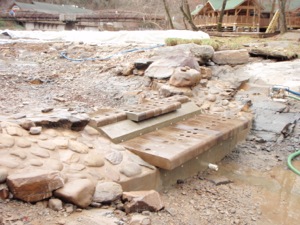 The construction of the wave shaper was completed in just under a month by the William Baxter Company during a time when the Nantahala Dam was turned off for maintenance. One of the biggest construction challenges was keeping this section of river completely dry.This was accomplished with a large “cofferdam” made out of 2 x 2 x 12 foot concrete blocks that surrounded the entire work site. Since a considerable amount of concrete was used to create the new wave shaper, six pumps and thousands of sandbags kept any water from coming in contact with the wet cement. This dewatering also allowed three large excavators to move rocks and chip away at the riverbed to deepen the pools.
Following the initial construction, the project now enters a “tuning” phase where the wave shaper’s blocks and “tuning zones” can be adjusted. A small focus group of professional paddlers and instructors has been recruited to provide on-the-water feedback directly to the project engineers. Aside from the pros’ input, a dedicated group of local athletes, some of which worked on the original hand-made feature, have also provided important input for tuning. While the initial construction took only a month, it is expected that the tuning will take longer as fine adjustments are made - and the project team is 100% committed to creating the best kayaking feature in the world.