
 M. DAWSON
 J. CLARKE
 M. SMOLEN
 E. FER
 C. KUHNLE
 M. CHOURRAUT
 M. BENUS
 F. ANTON
 L. BOZIC
 K. HOSKOVA
 J. FOX
 BREZINSKI/BREZINSKI

 A. PETERS
 V. KHUDZENKA
 E. MEDVECKZKY
 GRIJIC/NOVAKOVIC
 L. QIANG
 M. DE JONGE
 R. POULSEN
 A. CHERVOVA
 S. TARNOVSCHI

 J. MOCKE
 E. LEVEMYR
 S. RAFAEL
 H. TAKAKU

 M. GRAZIANI
 J. EGAN
 N. LJUBEK
 MINDE/HAMAR
 PINTA/MOZZICAFI
 S. LAMMLER
 A. BUSLAIEVA
 M. WEGMAN
 S. REINOSO
Amazon: Where time has a different measure
A story about an expedition down the Amazon River with all its beauty and danger
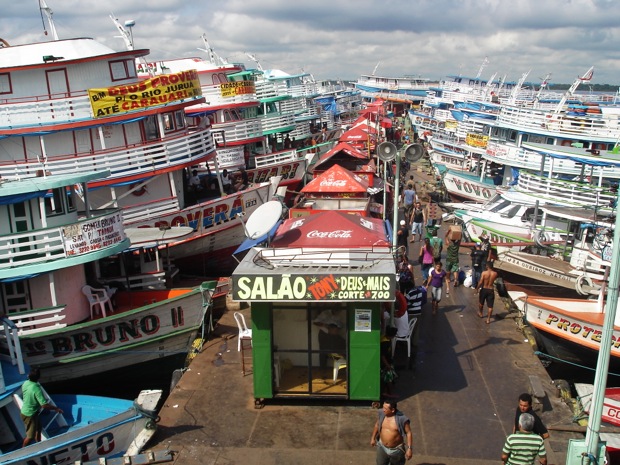
Story and photos: Iran Schleder | Proofreader: Ros Lawrence | Sportscene - As soon as the aeroplane approached the Eduardo Gomes Airport in Manaus, we already had the impression, the strong feeling, that time has a different currency in this city.
It was difficult to be in a place with so much to admire. The reason I went there was not to explore the natural beauty of the “Garden of the Earth”, as the Brazilian writer Darcy Ribeiro once referred to the Amazon. I was there to join in the first kayak expedition to Manaus/Belém, a journey on which I traveled hundreds of kilometres down the Amazon River, assisted by a great team, collecting images, stories and observations of life in another part of Brazil, where time is not measured by a clock.
At the river port of Manaus, we felt the enormity of the Amazon. There were hundreds of people that went about in what is referred to as the “commercial heart of the Amazon”, an amazing and unforgettable place. Every minute we saw someone carrying boxes full of fruits, nuts, fresh meat, fish and thousands of unseen foods. There are infinite goods and products found only in that part of the world and this makes them highly sought after by foreign industries, cosmetic companies and chefs from all over the world.
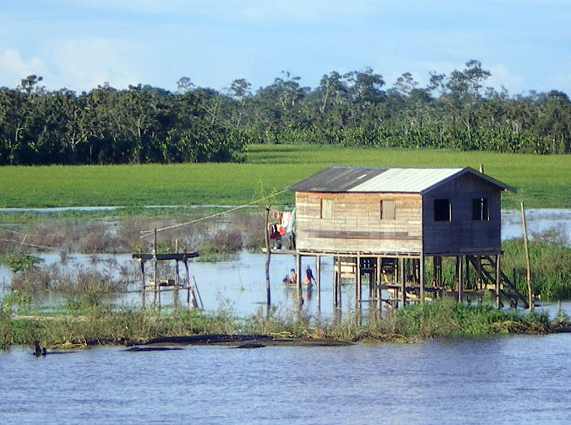 The humidity there was suffocating and I got up several times during the night to take a shower, because the heat was unbearable. When the expedition crew walked from the hotel to the harbor, we talked about canoeing, soccer and how uncommon the weather was for me. On the way I was fascinated by the beauty of Manaus. Although far from being the biggest commercial center in Brazil, it is as rich as the capitals of the other Brazilian states. Manaus is an extraordinary and beautiful city. Its colonial European architecture contrasts with the exotic fruits and animals and the mixed population, featuring whites, blacks and natives. The lifestyle in Manaus is completely different to the one most people are accustomed to seeing in Brazilian cities, especially in the South.
We arrived at the port and Captain Francisco Souza Santos, also known as Tomé, greeted us on the Geretepaua boat, which in the indigenous language means, “Abode of the turtle." The boat became our home for the next weeks.
Arriving on deck I realized that everyone was very excited about the journey that would take us nearly a thousand kilometres along the giant Amazon River. My expedition mates showed their excitement, anxiety, happiness and fear. To paddle for extended periods of time in one of the most isolated places on the planet in the midst of many natural hazards requires a lot of preparation, planning, and of course, courage.
Accustomed to the noise and haste of the city, I found the lifestyle of people living in the Amazon very strange. During the trip it was a very common occurrence to see parrots flying over the boat, an alligator resting on the banks, panthers lurking in the woods, and many other exotic animals. The routine of people whose lives are based around fishing and gathering plants was another cultural shock. Observing their manners and priorities, I realised life can be much simpler than what we are used to in modern society.
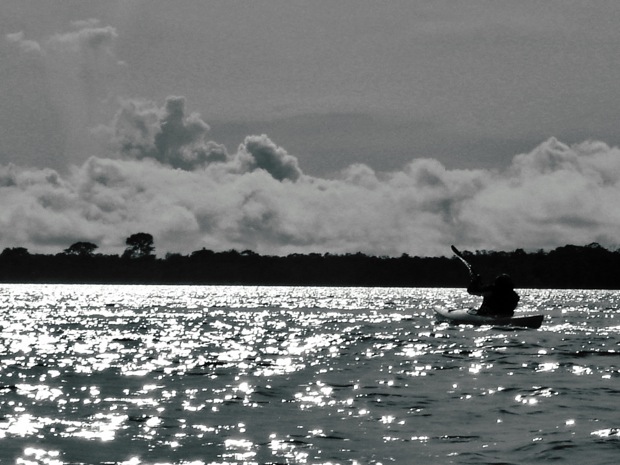
The adventure began where the world famous waters of the Solimões and Negro rivers join. Our canoeing expedition was a project lead by Evaldo Malato, president of the Pará State Canoeing Federation. The group consisted of sixteen people, including experienced paddlers, journalists, photographers and sailors. Our routine started at 5am each morning when everyone woke up, ate and prepared single and double kayaks for a day of paddling. We paddled for four hours in the morning, took a break for lunch on the main boat, rested for half an hour and then paddled for five more hours in the afternoon. At this time we would stop in isolated riverside communities which were difficult to access. We delivered gifts such as books, toiletries, toys and even food for people living in the bush. These people experience year round floods that consistently hit the Amazon River. The big flood that had most recently hit the area was considered the greatest flood to occur in the last fifty years.
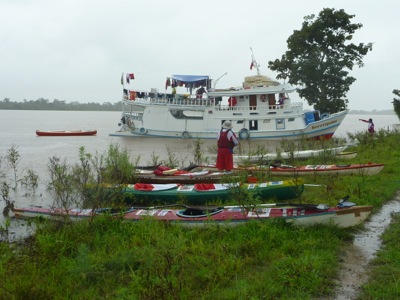 Philanthropy was a major objective of the first kayak expedition to Manaus/Belém. We distributed more than 20,000 textbooks to riverside schools as well as tens of hundreds of toys, dental hygiene kits and food baskets, which were distributed to needy people. Besides the delivery of donations, there were also educational presentations conducted on the importance of environmental preservation. What was most striking, was that canoeing is a sport with the face of the Amazon. Travelling along the riverside communities it was easy to find children and youth using canoes to get around in the largest watershed in the world. We asked parents and teachers about the practice of traditional canoeing in the region, and we were told that children usually learn to paddle long before they can even read or write.
Further goals of the expedition were to develop canoeing in the region, show the natural beauty of the states of Pará and Amazonas, alert the population to the importance of environmental preservation in the region and to appreciate and praise the habits and customs of the Brazilian people of these regions. The kayaks that were part of the first kayak expedition to Manaus/Belém aroused the curiosity of children as they passed by. According to Evalto Malato the implementation of canoeing in the schools of the region had already begun,
"We intend to disseminate the sport across the north of the country and we are confident that from here a future champion may arise.”
The first canoe expedition to Manaus/Santarém was a great example of solidarity for all Brazilians. The team of paddlers left Manaus and travelled to Belem, which is more than 2,500km along the Amazon River, and delivered more donations to riverside communities often forgotten due to poor accessibility. In addition to philanthropic work, the initiative of this type of project is very important to the region's children,
“For us a little means a lot, since we lost almost everything in the flood. This type of work you do is blessed.”
During this trip, there were many meetings with local people and many tears on both sides, showing us all that solidarity, from sincerity, is one of the instruments of pleasure for humans, who can realize in one act that life is far greater than the comforts of home, or even a plate of food. In such instants we realized that happiness can be much simpler than we imagined. During several moments of contemplation I thought about the words of Machado de Assis, one of the best Brazilian writers:
“Time is an invisible chemical that dissolves compounds, and extracts and transforms all moral substance.”
|
The Legend of the Origin of the Amazon River
A long time ago there lived in the Amazon Jungle two would be lovers who dreamed of being a passionate couple. She was dressed in silver and her name was Moon and he was dressed in gold and his was Sun. Moon was the mistress of the night and Sun was the owner of the day. Sadly there was an obstacle to their union. If they married the world would end. The ardent love of Sun could burn the whole earth. The sad cry of Moon would drown all the land on Earth. Though passionate, how could they marry? Could Moon extinguish Sun’s fire? Should Sun evaporate all the water? Passionate, separated, they could never get married. Moon was so sad, that in the desperation of longing she cried for a whole day and night. Her tears ran down endless hills until they reached the sea. But the wild ocean would not take so much water. The moon could not mingle her tears with the salt waters of the sea, and at once something strange happened. A huge river came, flooding valleys, forests and endless other places. The waters formed by the tears of the moon dug a huge valley, where many mountain ranges also rose. They were the tears of the moon, whose sadness formed the Amazon River. “At the extreme height of the ridge, where the snows are eternal, water dislodges and draws a shaky rift through the skin of old stone. The Amazon River has been born” |
|
The Amazon – Fast Facts
- total area, Grand Amazon: 7,584,421 km² (including 9 countries) Worldwide, it is estimated that there are 19 million km² of tropical forests. The Amazon region has 3.65 million km² of continuous forest, the largest of its kind in the world. The annual rainfall in the Amazon basin is 15 trillion m³. Of that amount, an average of 48% is used by the Amazon’s ecosystem in a constant cycle of evaporation and transpiration, the other 52% flows through the rivers. A study conducted in the rainforest ecosystem showed that 25% evaporates, 50% transpires and 25% drains into the rivers. The total deforested area of the Amazon is about 500,000 km² or approximately 12.5% of the original forest. In the 80's, in Rondonia State, the deforestation rate was about 35,000 km² per year, equivalent to one football field every 5 seconds. Today the rate of deforestation in the Amazon has more than halved.There are about 5,000 tree species in the Amazon. In comparison, North America only has about 650 tree species. The diversity of trees in the Amazon varies from 40-300 different species per hectare, while in North America there are only 4-25 per hectare. Of the 250,000 species of higher plants on earth, 170,000 (68%) grow exclusively in the tropics, and 90,000 of these in South America. The PopulationNearly 17 million people live in the Amazon, with a population density of approximately 3.4 inhabitants per km². 62% of the population lives in urban areas and 38% in rural areas. On average the native inhabitants use about 3.2 hours a day for agriculture and 5.1 hours a day for hunting, fishing and gathering. The oldest ceramics found in the Amazon date back to 5-6000 BC. 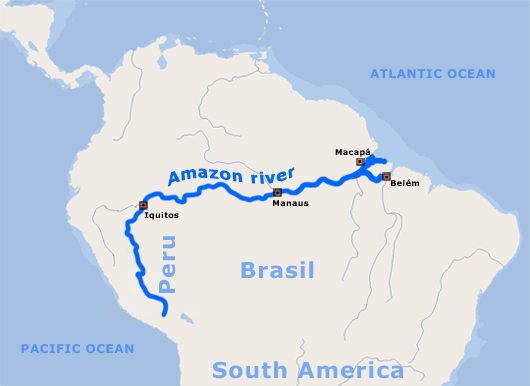 The Rivers The Rivers
The volume of water flowing through the Amazon River mouth is 100,000-300,000m³ per second, depending on the season. Considering the average of 200,000m³ per second, this means that the daily consumption of a local town would be supplied by one second of river flow. The water of the Amazon River accounts for approximately 17% of all liquid water on the planet. The average depth is 40 to 50 meters and near Obidos it can reach a depth of 100 metres. There are about 3,000 species of fish in the Amazon, which represents 85% of the total amount found in South American waters and 15% of those found in continental waters. More than 80 species of ants were found on a single plant in the Amazon - double the number of species of ants found in the British Isles.
|