
 M. DAWSON
 J. CLARKE
 M. SMOLEN
 E. FER
 C. KUHNLE
 M. CHOURRAUT
 M. BENUS
 F. ANTON
 L. BOZIC
 K. HOSKOVA
 J. FOX
 BREZINSKI/BREZINSKI

 A. PETERS
 V. KHUDZENKA
 E. MEDVECKZKY
 GRIJIC/NOVAKOVIC
 L. QIANG
 M. DE JONGE
 R. POULSEN
 A. CHERVOVA
 S. TARNOVSCHI

 J. MOCKE
 E. LEVEMYR
 S. RAFAEL
 H. TAKAKU

 M. GRAZIANI
 J. EGAN
 N. LJUBEK
 MINDE/HAMAR
 PINTA/MOZZICAFI
 S. LAMMLER
 A. BUSLAIEVA
 M. WEGMAN
 S. REINOSO
The Ultimate Loop (not just a freestyle move!)
 Most virgin plastics are produced from crude oil, which is found trapped in sedimentary rocks in the Earth’s crust. Millions of years ago, plant and animal remains on the sea bed were covered by layers of silt and sand. Over time, these remains were buried deeper and deeper; under immense temperature and pressure, the remains were turned into oil and gas.
We call crude oil a non-renewable resource, as it took millions of years to form and we’re using it up much faster than it can be replaced. As a result, it’s really important that we make best use of the oil once it has been extracted in order to help conserve this valuable natural resource.
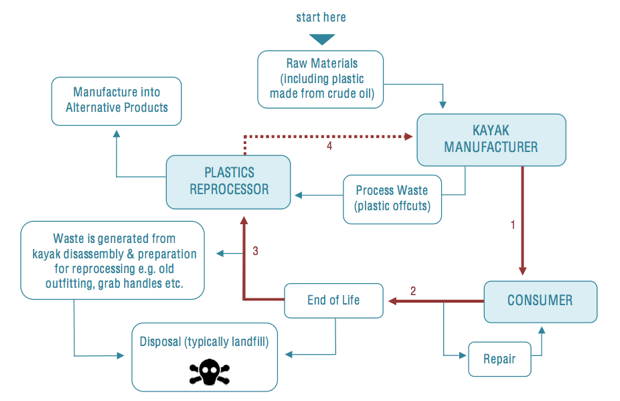
Check out the ‘ultimate loop’ below - it shows the recycling processes that we could consider below to see how we might be able to close the loop for recycling our kayaks, and help to ensure that the plastic doesn’t get wasted.
In the diagram above, stages 1 & 2 happen regularly - new boats will be sold and older boats will reach the end of their life. Occasionally a boat will make it through to stage 3, where it will be recycled into a new, alternative product, such as a water butt or drainpipe. At the moment, stage 4 isn’t happening; this is ‘closed loop’ recycling, when a product reaches the end of its life and is reprocessed into an identical product (for example, glass bottles being recycled back into new glass bottles). So, what are the challenges to closed loop recycling? Is it even possible to turn an old kayak into a new kayak? And what more can we do to make sure that our old and broken boats don’t end up filling holes in the ground?
About kayak manufacturing
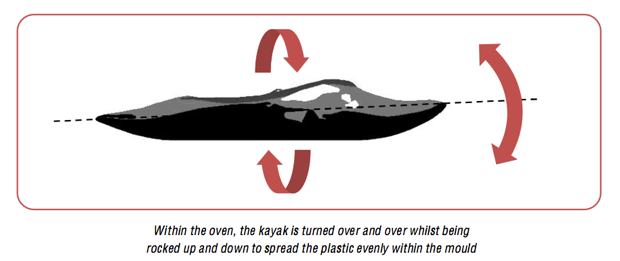
Plastic hulled kayaks are manufactured through a process called rotomoulding (rotational moulding). Plastic powder is placed into an open mould. The mould is then closed before being heated in a large oven. As the mould is heated, it is rotated about two axes to help spread the plastic evenly on the inside surface of the mould. The mould is then cooled before the plastic product is ready to be removed from the mould.
Most plastic hulled kayaks produced in the UK are made from superlinear high density polyethylene (HDPE), which is a similar material to a plastic bucket that you might have at home, except that the plastic used for kayaks is higher density. Choosing the right plastic polymer type is important, as higher density plastics can make the boat stronger, but if the density becomes too high this can make the boat brittle. This means that that when the plastic is impacted it would shatter rather than puncture, making it much harder to repair.
To read more about The Kayak Recycling Project by Beth Ripper download the pdf file (3MB) below.