
 M. DAWSON
 J. CLARKE
 M. SMOLEN
 E. FER
 C. KUHNLE
 M. CHOURRAUT
 M. BENUS
 F. ANTON
 L. BOZIC
 K. HOSKOVA
 J. FOX
 BREZINSKI/BREZINSKI

 A. PETERS
 V. KHUDZENKA
 E. MEDVECKZKY
 GRIJIC/NOVAKOVIC
 L. QIANG
 M. DE JONGE
 R. POULSEN
 A. CHERVOVA
 S. TARNOVSCHI

 J. MOCKE
 E. LEVEMYR
 S. RAFAEL
 H. TAKAKU

 M. GRAZIANI
 J. EGAN
 N. LJUBEK
 MINDE/HAMAR
 PINTA/MOZZICAFI
 S. LAMMLER
 A. BUSLAIEVA
 M. WEGMAN
 S. REINOSO
What makes Paracanoe different?

I am often asked about what makes Paracanoe different from able-bodied (AB) canoeing. It is a bit of a tough question to answer because I have never been an able-bodied canoe or kayaker. That being said, I felt it was important to point out some of the more apparent differences between the two disciplines.
Paracanoers come, very literally, in every shape and size. We all come from incredibly diverse backgrounds. Some have acquired disabilities (through various astounding experiences) and some have had their disability since birth. We have individuals with spinal cord injuries, amputations, polio, spina bifida, cerebral palsy, multiple sclerosis, Charcot-Marie-Tooth disorder, and many many others. We have female and male canoe and kayakers; we have athletes that range in age from their late teens to their late seventies. We have athletes that have restricted movement in one or more of their limbs, others that are missing limbs. Some Paracanoers have very obvious disabilities, while some have impairments that are almost invisible.
So, do I feel that Paracanoeing is different than able-bodied canoe and kayaking? Yes. For many reasons.
Access. Most Paracanoers cannot carry their own boat down to the dock; others cannot get in to or out of their boat on their own. Many canoe clubs are in old and/or make-shift clubs that do not have ramp access or a wheelchair accessible washroom.
Organization. Our races are separated by four different factors: gender, discipline (canoe or kayak), distance, and classification. Our classification is determined by health care professionals before racing begins and it determines our functional paddling level. The three levels we currently race in are LTA (meaning you can use most of your legs, trunk and arms), TA (just use of your trunk and arms), and A (just use of your arms). It is important to remember, though, that it is not easy to tell which classification someone may fit into; there are many conditions that make it hard for classifiers to determine a classification.
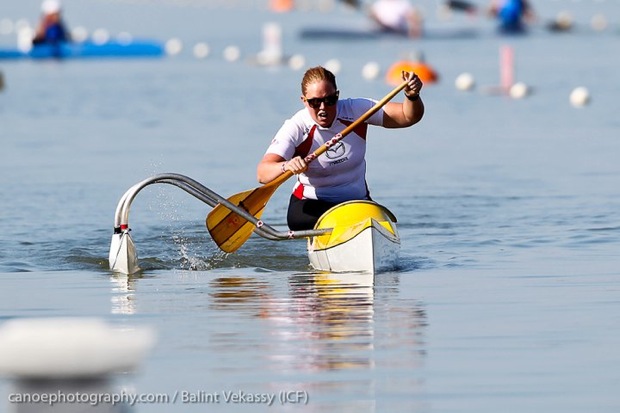 Technique. Not all of us are able to paddle in the way that our able-bodied counterparts do because of our physical limitations. This means that we may not be able to "pump" our legs, twist our trunk, operate a rudder or hold the paddle with the technique that is used in AB canoeing. We play to our strengths and adapt our technique to fit each person's unique needs.
Equipment. Our kayaks are often bigger, heavier and have flatter bottoms. Our canoes have an ahma (a large pontoon) on one side, and vary greatly in size, shape and weight. We use outrigger canoe paddles for canoeing, which are differ in both shape and length (as compared to an AB canoe paddle). Some Paracanoers have specially-designed seating, some paddle with a regular seat and still others paddle without a seat at all. Some use specially-designed steering systems and some have specially-designed prostheses specifically for paddling. New equipment is being developed every year, meaning that our equipment is as unique as the individual using it.
Experience. Paracanoe is still a new sport, meaning that our athletes did not grow up in the sport. In many cases, Paracanoers did not grow up playing any form of competitive sport. The sport world in general is new to many of us, which creates stress and anxiety at competition time.
Coaching. Our National Team coaches are teaching the basics of the sport they know very well to individuals that are much older than they are. We rely on our coaches to drive us around, because renting vehicles with hand gears is incredibly difficult. We rely on our coaches to manage our equipment and move our wheelchairs or prosthetic limbs from one dock to another. Our coaches need to know what each individual on their team can and cannot do, and they need to create programs and adapt equipment according to those abilities. Coaching a team of individuals with disabilities is incredibly different than coaching a team that is able bodied.
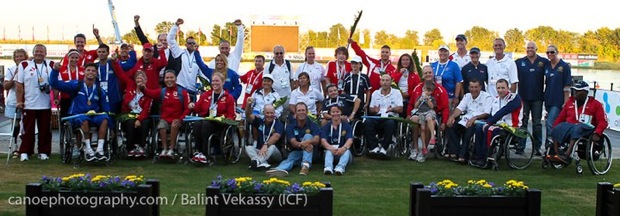
Media coverage and audience. Whereas the able-bodied sports pull in massive crowds and are broadcast on several stations, ParaSports (in general) are usually not broadcast at all. Even the Paralympics have trouble getting broadcasting time.
What we do outside of sport. Many Paracanoers are older than their AB counterparts, meaning that they have several responsibilities outside of paddling. They have families and careers; finding the time to train can be a challenge in-of itself.
Financial challenges. Living with a disability is already very expensive, and the funding for Parasport is often less than the funding provided to able-bodied sport. Taking on any Parasport at a competitive level (with club fees, coaching fees, travel, and equipment) is a challenge in an already difficult financial situation.
Yes, Paracanoe is different from able-bodied canoeing. It is different in almost every way, but that certainly does not mean that what we do is any less important or that our AB counterparts do not incur any of the challenges listed above. Many Paracanoers have overcome hurdles in our lives that our AB counterparts cannot even fathom but when it comes to racing, our goals are a lot the same. Both groups paddle as hard, fast and straight as we possibly can until we pass that finish line. First.
Also
- 'True Winter Tales' by Christine Selinger
- Video interview with Christine Selinger