
 M. DAWSON
 J. CLARKE
 M. SMOLEN
 E. FER
 C. KUHNLE
 M. CHOURRAUT
 M. BENUS
 F. ANTON
 L. BOZIC
 K. HOSKOVA
 J. FOX
 BREZINSKI/BREZINSKI

 A. PETERS
 V. KHUDZENKA
 E. MEDVECKZKY
 GRIJIC/NOVAKOVIC
 L. QIANG
 M. DE JONGE
 R. POULSEN
 A. CHERVOVA
 S. TARNOVSCHI

 J. MOCKE
 E. LEVEMYR
 S. RAFAEL
 H. TAKAKU

 M. GRAZIANI
 J. EGAN
 N. LJUBEK
 MINDE/HAMAR
 PINTA/MOZZICAFI
 S. LAMMLER
 A. BUSLAIEVA
 M. WEGMAN
 S. REINOSO
Fighting back illness all the way to the top, interview with Claire Gunney
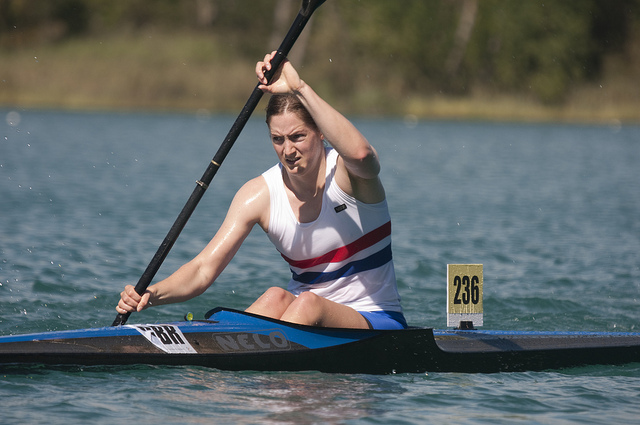
Claire Gunney, Britain’s strongest female marathon paddler of the last few years, announced her retirement late last year. After having battled with a severe case of Chronic Fatigue Syndrome, that should have taken her out of the sport completely, she fought back and made it to the European in 2011 and World Championships in 2010.
Could you briefly describe how and when you first started kayaking, and a summary of the first part of your career?
I started kayaking at 10, following after my sister who had done as summer fun course. As soon as I was old enough I joined Wey Kayak Club, starting in the beginner groups and gradually progressing, I became part of the Junior Olympic racing squad when I was 14. I went to my first European Championships (for sprint) when I was 16, and reached the semi-finals in k2. As a junior I competed internationally for GB at sprint (2 European championships 1 world championships and several world cups) and marathon (2 World Championships and 2 World Cups). I won a marathon World Cup in Italy when I was 17 in k2, and the following day I raced k1 and came 2nd. In Germany the following year I came 2nd in k2.
And then the problems with illness emerged?
When I turned 18 on the way back from the marathon world championships in Canada I picked up a bad chest infection which lasted several months. Upon returning from illness in 2001 I was promoted a division in Sprint, but was then involved in a serious car crash: suffering severe whiplash injuries, and was told I would never paddle again. After 5 months I was back in a boat. With a lot of therapy I started to return to full training; however, unfortunately over the next few years I struggled with illness, which was initially thought to be a heart problem.
Finally after 8 years of illness and being unable to train for more than a few weeks at a time, I was diagnosed with chronic fatigue syndrome. I was so ill and so exhausted at times I couldn't even pick up a knife and fork to be able to eat. Training wasn't an option as I was struggling to stay awake for more than a few hours. Once again I was told I wouldn't be able to paddle or race anymore. This was probably the lowest point of my paddling career; all the information I was given said that there was no cure and I would have to live with this illness every day. After seeking advice I tried reverse therapy, which helped me to manage my symptoms and gradually I managed to live life more normally. In time I started gentle exercise; with the help of reverse therapy I managed my first race within 6 months of starting the therapy which was unimaginable just a few months prior.
How difficult was it emotionally, having to take so long out of sport?
It was extremely difficult taking time out of sport as it was something I had done from such a young age, and had become part of my identity. What was particularly tough was that so many medical professionals said I would never get back in a boat.
Plus you had the additional dynamic of attending university – how did cope with sport, studying and then illness too?
I have always been very organised and learnt very early on in my canoeing career how to balance study and training. However it became apparent during my therapy that my compulsive and organised attitude was in fact making my CFS worse. Whilst I had been at school I had coped, but the additional demands of university combined with CFS made it a very difficult time.
Many people who suffer from C.F.S. never even come close to recovering properly, when you were at your worst (health-wise) – could you ever even imagine that you would be back racing at an international level?
It was very hard as almost everyone told me i would never compete again. I always remember trying to eat a bowl of pasta and not being able to lift my knife and fork to feed myself: at that point it felt like I would never be able to do even simple tasks.
Could you describe the stages of your recovery?
I was lucky enough to get advice from Anna Hemmings, and she pointed me towards Reverse Therapy - as the doctors had said there is no real treatment. Reverse Therapy was extremely hard, because I felt I couldn't get anything done. One of the rules for me was that I wasn't allowed to do any activity for more than 20 minutes without changing to something new. I also had to keep an activity log and do a set number of different activities everyday - which was really difficult when I just wanted to go training.
Gradually I was allowed to start training but it was extremely limited. This was extremely frustrating as I wanted to do more, but every time I tried I ended up ill again. My now husband, was my coach at the time, and I wasn't allowed to train unless he was there; he was extremely strict, and ensured I only did the prescribed amount of exercise. Eventually I was allowed to increase the training. The treatment began in April 2008, and I returned to international competition in 2010; the entire process of illness and recovery had been a very tough ten year journey.
How difficult was it balancing a full time job with your return to paddling?
The most difficult thing was not getting obsessed with work and/or training, and trying to incorporate other activities to reduce the likelihood that CFS would return. Most of the people I have been competing against internationally are full time athletes; but I have had to balance a full time job with trying to train hard enough to compete with these girls.
What has been your career highlight?
My career highlight has to be last season’s World Championships in Spain. I finished 8th, and the ICF rankings for 2010 had me at 2nd in the world, behind the world champion. After such a long fight it was amazing.
Could you describe why you came to the decision to retire at the end of 2011?
 April 9th 2011 I competed in a 5k race and despite winning, I realised my performance wasn't what it should have been. I started to identify the symptoms of CFS returning. I was always told this was very likely due to the nature of being an elite athlete and the obsessive training required. As the season progressed it became clear to me and my husband (coach) that the CFS was starting to return. I made the tough decision to achieve what I could from the season, realising this would be my last competitive season. I still had some good results: coming 5th at the World Cup in Rome, but as the season progressed my symptoms became more difficult to manage, and I had no real choice but to retire.
What do you think the future holds for you? Any chance of a return to paddling?
I am still training to keep fit; its good fun going to the club and the senior group I often paddle which makes it enjoyable. The sessions aren’t too serious, and it is good to still see the people I have known from paddling, as I have spent so much of my life around the sport. I have made the decision to retire based on my health, and I am not risking getting that ill again
And finally, being 2012: what do you think the highlight of the Olympic Games will be for you?
For me the Olympic Games is an opportunity to watch the best athletes in the world competing in a range of sports. I enjoy the whole fortnight, and this time I will be able to watch it without having to worry about my training or analysing training techniques of the other paddlers competing.