
 M. DAWSON
 J. CLARKE
 M. SMOLEN
 E. FER
 C. KUHNLE
 M. CHOURRAUT
 M. BENUS
 F. ANTON
 L. BOZIC
 K. HOSKOVA
 J. FOX
 BREZINSKI/BREZINSKI

 A. PETERS
 V. KHUDZENKA
 E. MEDVECKZKY
 GRIJIC/NOVAKOVIC
 L. QIANG
 M. DE JONGE
 R. POULSEN
 A. CHERVOVA
 S. TARNOVSCHI

 J. MOCKE
 E. LEVEMYR
 S. RAFAEL
 H. TAKAKU

 M. GRAZIANI
 J. EGAN
 N. LJUBEK
 MINDE/HAMAR
 PINTA/MOZZICAFI
 S. LAMMLER
 A. BUSLAIEVA
 M. WEGMAN
 S. REINOSO
An Introduction to Quadrathlon
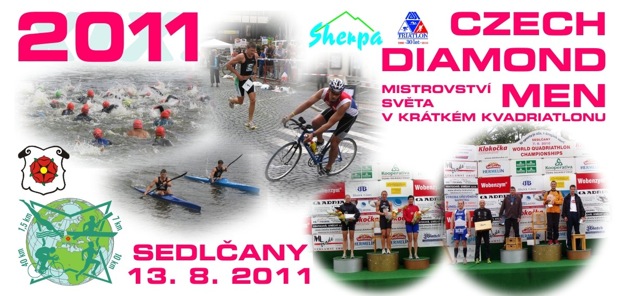
For anyone who has never heard of a quadrathlon, the premise is simple: swim, paddle, cycle and then run – pretty much a triathlon with paddling thrown in for good measure. The swims are usually open water and are normally 1.5km, followed by a paddle of between 7km-10km, a 40km cycle and then a 10km run – not a sport for the fainthearted.
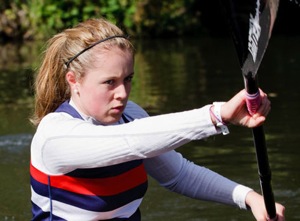 I first heard about quadrathlon a few years ago after reading about it in ‘Canoe Focus’ – the British Canoeing magazine, and I was instantly intrigued. Coming from a background in both triathlon and kayaking – this amalgamation of the two seemed to be a sport created for me. However my first attempt at a quad was not until earlier this year, after my on-going and lengthy battle with glandular fever had prevented me from returning to kayaking. Most of the races in the past had been a reasonable distance from where I live and train, but this year there was a greater spread and the sprint-distance national championships were not too far away. The distances were far better suited to a first-timer, with a 750m swim, 4km paddle (with two portages), 15km cycle and a 5km run – still a challenge, but not quite as daunting!
When race day arrived I placed my boat in the transition area alongside the others. Being a paddler, my boat is my priority, so I have a beautiful pink and navy striped Plastex (the 8kg Fighter 65 construction) – which is probably the most precious thing I own. After lining my boat up with the others, I did notice how much it stuck out from the rest – some of which were rudderless, and some of which were even sit-on-tops! I realised then that the paddle was definitely going to be my strongest field – which I needed given how weak my cycle was going to be (I was attempting to race a mountain bike course on a city-bike).
Nevertheless, I waded into the lake in an attempt to warm-up before the swim. I was prepared for ankle-grabbing and the likes (as a marathon paddler you get used to rough racing) – but I was not prepared for how scary this was. As a 17-year old girl and a first-time – battling your way through a field of men was a little intimidating! I struggled to find my rhythm, which was infuriating as in a pool I am usually a strong swimmer – I ended up (much to the amusement of other people) swimming large chunks on my back, which proved to be a rather efficient method. Eventually I finished the swim in a good position and charged to my paddles and then my boat, and headed off on the paddle. This went well, and I was amazed to discover that when I got out for the cycle – people took my boat for me. The rest of the race was long, arduous and challenging – not helped by the July heat; but it was a great experience and a good way to get myself back into racing.
2011 World Championships Czech Republic
Not put off by the experience, a few weeks later I found myself in the Czech Republic, preparing for the World Championships. I felt better equipped to face this challenge, and it was a good opportunity to get to know the rest of the British team – who are a really interesting and fun group, and made the trip so enjoyable.
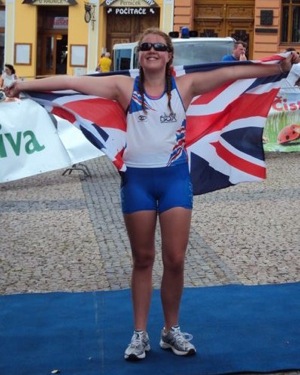 We spent two days getting to know the course, prepping ourselves for the undulating cycle and the relentless run course. When it came to the day of the race I spent most of the morning examining the other boats and bikes in the transitions – and my boat (despite its unsubtle colours) seemed more at home here. This unnerved me greatly – I knew with my fitness I had to rely on my paddling to pull me through. I then spent a good 45 minutes or so inspecting every boat until I knew which belonged to my rivals – my heart sank when I spotted a haul of Nelo. Feeling a little despondent, I jumped into the lake and got ready for the swim. If there is one thing I have learnt in all my years of paddling, it is how to push a start. Not something I should be overtly proud of – but when you train with teenage boys and coach teenage boys – you have to learn to hold your ground. I made my way to the front of the start and waited for the horn to sound. I swam as hard as I could to make a break from the other juniors around me, and found myself hyperventilating as I went round the first corner. I rolled onto my back again, despite promising I wouldn’t, and proceeded to swim backstroke before settling in to my own rhythm on my front. The swim went well, and I was one of the first juniors to come out – putting me in a great position for the paddle.
The paddle went well, and as it was lap based I could always keep my competition in sight, and I knew I was ahead. I leapt out of my boat and sprinted up the hill to my bike, ready for my 20km ride (juniors only do half-distances), which was most certainly going to be my weakest. Luckily, I was able to hold the competition off and stay ahead for the run. The run was a windy course through the back streets of Sedlcany – over railway lines and rivers, past a pink castle in the middle of the woods and out onto the main road again. I was overtaken at this point by a member of the Spanish team (a senior on his final lap); I used this opportunity to exercise my Spanish skills and asked him “¿hay una chica cerca de aquí?” He laughed, and told me there was a girl nearby and to run fast. I took this on board and ran for my life, and finally crossed the finish line with a flurry of tears as World Champion. The rest of the team were amazing, and despite crashes (before and during the race) everyone finished with some great results.
Whilst kayaking is my main sport and continues to be for the foreseeable future, I am surprised that more paddlers don’t try Quadrathlons as well. From what I can ascertain, the stronger paddlers are the ones that seem to prevail, and considering how much we all cross-train it would seem logical for more of us to switch over. Quadrathlon is not a big sport at the moment, but with more and more races being added to the calendar each season it is a really exciting time to be involved in Quad!