
 M. DAWSON
 J. CLARKE
 M. SMOLEN
 E. FER
 C. KUHNLE
 M. CHOURRAUT
 M. BENUS
 F. ANTON
 L. BOZIC
 K. HOSKOVA
 J. FOX
 BREZINSKI/BREZINSKI

 A. PETERS
 V. KHUDZENKA
 E. MEDVECKZKY
 GRIJIC/NOVAKOVIC
 L. QIANG
 M. DE JONGE
 R. POULSEN
 A. CHERVOVA
 S. TARNOVSCHI

 J. MOCKE
 E. LEVEMYR
 S. RAFAEL
 H. TAKAKU

 M. GRAZIANI
 J. EGAN
 N. LJUBEK
 MINDE/HAMAR
 PINTA/MOZZICAFI
 S. LAMMLER
 A. BUSLAIEVA
 M. WEGMAN
 S. REINOSO
Contributors - Paddlesports Back to overview
Surf Kayaking
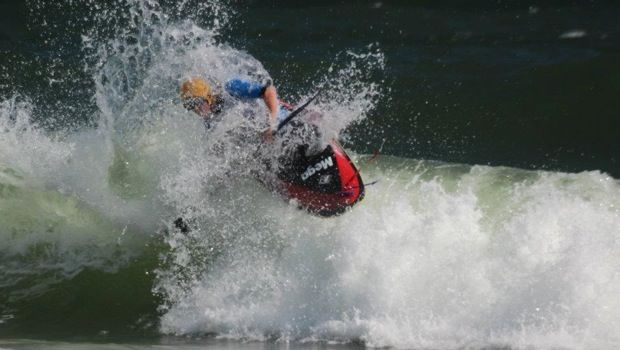
Accessible to anyone with a whitewater or freestyle kayak, surf kayaking is, at heart, just turning up at the beach and wave-riding. Even when sea-kayaking or surfskiing, launching and landing through surf could be considered as canoe surfing.
However, such long vessels really aren't that manoeuvrable in breaking waves. This is why smaller crafts with low turning circles used in other kayak disciplines have become the norm. Most surf kayaks are specially designed though with hard edges, flat bottoms, upward pointing slipstreamed noses and 3 to 4 fins, all similar to surfboard design in hindsight.
True some freestyle moves likes turns, spins and the odd over-the-lip kick out can be attempted, yet kayak surfing is essentially about catching the wave and maintaining the length of the ride – hence why braces and stern rudder strokes play a vital role in controlling the paddler's balance. The sport tests paddlers' timing, knowledge of wave formation and currents, technique, impactive acceleration (when catching the wave), balance, agility and ability to roll.
Governed by the World Surf Kayak Association, World Championships are held every odd 2 years, 2015 will be held in Galicia, Spain, the first World's took place back in 2011.
Neither surf kayaking nor any type of other surfing, whether it be paddle surfing, waveski, shortboarding, longboarding, kneeboarding or bodyboarding, is currently an Olympic discipline.