
 M. DAWSON
 J. CLARKE
 M. SMOLEN
 E. FER
 C. KUHNLE
 M. CHOURRAUT
 M. BENUS
 F. ANTON
 L. BOZIC
 K. HOSKOVA
 J. FOX
 BREZINSKI/BREZINSKI

 A. PETERS
 V. KHUDZENKA
 E. MEDVECKZKY
 GRIJIC/NOVAKOVIC
 L. QIANG
 M. DE JONGE
 R. POULSEN
 A. CHERVOVA
 S. TARNOVSCHI

 J. MOCKE
 E. LEVEMYR
 S. RAFAEL
 H. TAKAKU

 M. GRAZIANI
 J. EGAN
 N. LJUBEK
 MINDE/HAMAR
 PINTA/MOZZICAFI
 S. LAMMLER
 A. BUSLAIEVA
 M. WEGMAN
 S. REINOSO
Two months to go to whitewater heaven
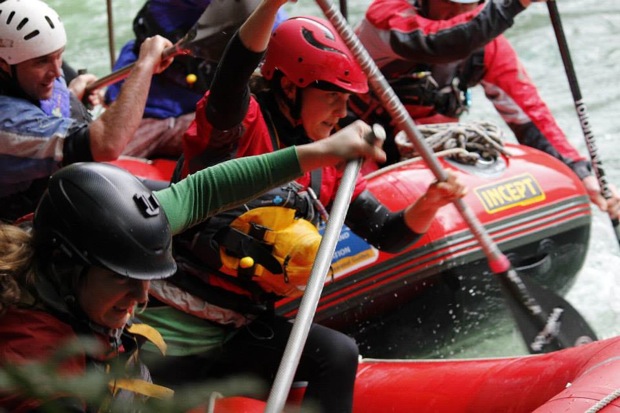
The countdown is on to the 2013 World Rafting Championships with just two months to go before 70 plus teams from more than 30 countries come to New Zealand and the Bay of Plenty to go for gold.
The event runs from November 13th through to November 24th and will be hosted by Rotorua and Kawerau on three famous stretches of rafting water – the Kaituna, Tarawera and Rangataiki rivers.
Work on the venues has been going on for some time, and competitors are being promised some extreme challenges over the ten day event – which will include downriver, sprint, head to head, and slalom challenges. A Pre-Worlds event held in October 2012, designed to test the quality of the courses for international competition, was also a success.
“We’re the envy of many countries in the world when it comes to extreme and challenging water that is suitable for rafting,” explained organising committee member, Team Liaison and white water rafting enthusiast Raewyn Larcombe.
It’s already providing fantastic profile for the region internationally, with a compact but global community following us every step of the way as we build towards the start of the event.
The volunteer recruitment programme is also up and running, with an event requirement of around 150 volunteers expected to be met easily from a growing NZ rafting community and from the local Rotorua and Kawerau areas.
Waiariki Institute of Technology in Rotorua will provide accommodation for the international teams, as well as the event press office. Social media is popular in the rafting community globally, and this will form the main thrust of the event media effort, with daily news reports and footage being posted onto the site at the end of each day of competition in time for the European and US ‘mornings’. The Facebook site alone is currently attracting around 150 new international followers every day.
Challenging terrain and back country locations for the rafting courses means that the best chance the public will have to see the event close up will be the slalom competition at Tarawera on the penultimate day when the big guns of rafting will battle it out. Kawerau District Council are already at a very advanced stage of planning and marketing of their big day and are hoping to attract thousands to the event, when they will also be holding a festival.
Local schools in the region are also jumping on board with an ‘Adopt a Nation’ programme being championed by Kawerau District Council.
DRAFT PROGRAMME
- Wednesday 13 November 2013 – Official Practice Under 19/Under 23
- Thursday 14 November 2013 – Official Practice Under 19/Under 23
- Friday 15 November 2013 - Time Trail and Head to Head Under 19/Under 23- Tarawera
- Saturday 16 November 2013 - Slalom Under 19/Under 23- Tarawera
- Sunday 17 November 2013 - Downriver Under 19/Under 23- Rangitaiki
- Monday 18 November 2013 – Senior/Masters Official Practice
- Tuesday 19 November 2013 – Senior/Masters Official Practice
- Wednesday 20 November 2013 – Senior/Masters Official Practice
- Thursday 21 November 2013 – Senior/Masters Time Trail - Kaituna
- Friday 22 November 2013 – Senior/Masters Head to Head - Kaituna
- Saturday 23 November 2013 – Senior/Masters Slalom - Tarawera
- Sunday 24 November 2013 – Senior/Masters Down River – Rangitaiki
Links
- Event website: www.2013raftingworldsnz.com
- Facebook Page: www.facebook.com/2013WhiteWaterRaftingWorldsNZ
|
World Rafting Championship History
The World Rafting Championship has its origins in the international events of Project RAFT in which up to 50 teams competed in various disciplines including Slalom and Down River on the Chuya river, Siberia (1987), Nantahala river, USA (1989), Reventazón and Pacuare rivers, Costa Rica (1991) and Coruh river, Turkey (1993). In 1994 a World Champs was held in Italy on the Dora Baltea River and it was there that many key participants saw the need to form an international body to represent all racers, rafters, guides and all aspects of rafting.After that the Camel White Water Challenge (CWWC) took place on the Zambezi River, Zimbabwe (1995–1997 and 2001), Reventazón and Pacuare rivers, Costa Rica (1998), Orange river, South Africa (1999) and Futalefu river, Chile (2000). The last three events were given the status of World Championships and for this reason the teams had to qualify through selection events at the national and continental levels in coordination with the International Rafting Federation (IRF). In the year 2000 the IRF resolved to hold the World Rafting Championships every 2 years and eliminate the selection events at the continental level to facilitate the development of the sport at the international level.The World Rafting Championships have been held on the Reventazón and Pacuare rivers, Costa Rica (1998), Orange River in South Africa (1999), Futalefu River in Chile (2000), Gauley River in USA (2001), Vltava River in Czech Republic (2003), Quijos River in Ecuador (2005), Naerinchon River in South Korea (2007) and Vrbas and Tara Rivers in Bosnia & Herzegovina (2009). In 2010 the IRF held their first ever R4 (4-man raft) World Champs which would now alternate yearly with the R6 World Champs. This first R4 event was hosted by Dutch Water Dreams on the artificial course in Zoetermeer, Netherlands (2010) and 2011 saw a return to a different section of the Pacuare River in Costa Rica. The New Zealand event will be the first time the R6 Masters have been included in a world championship and the first time juniors have been split into two sections – Under 19 and Under 23. There are currently 23 teams in these two categories. As a result, this will be the biggest ever World Rafting Championship event by category. 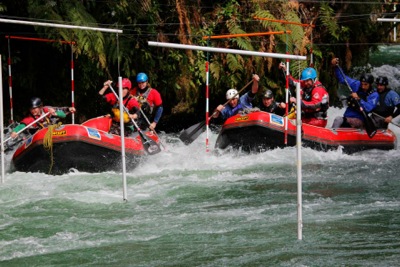 Team selection Team selection
The teams that attend the WRC are selected by their national federations through fair and credible selections. The top men’s and top women’s team from each member federation is eligible to attend. Teams consist of 6 paddlers and 1 reserve for R6 and 4 paddlers and 1 reserve for R4. DisciplinesRafting competitions consist of 4 disciplines – Sprint, Head-to-Head (H2H), Slalom and Downriver. The points earned in each discipline are added to determine the Overall winner and final positions. Each team has 6 members with the option to have a reserve.The Sprint is a hard, fast, short burst of speed for the teams. It is ideally over a fairly short distance and is about 2 to 3 minutes of hard paddling for 10% of the overall points. It is always done first, cannot be on a Class 5 rapid and teams are set off one by one, hence racing the clock and not each other. The H2H (Head to Head) is without doubt the most visually exciting discipline as it is pitting two teams together in a fast paced sprint for the finish line. It is ideally over a shortish distance but must be through a rapid, normally taking teams about 2 to 3 minutes to run the course. The two teams are set off together with the team having the best time in the Sprint being given lane choice. Although the race organisers always try to have the lanes as even as possible this is not easy as a river is so dynamic and changing river levels can also create problems. Ideal locations for a H2H have more than one line through the course allowing teams to overtake. It counts for 20% of the total points and is an elimination race in which pairs of teams race down a section of powerful rapids. The winner of each heat proceeds to the next round and eventually just 2 teams will remain for the Final.The Slalom is the most technically challenging event and counts for 30% of the total points. This event demands a high level of technique and teamwork to negotiate the rafts through 12 downriver and upriver gates in powerful rapids. Touching, failing to pass or intentionally moving a gate results in a penalty. Each team runs the course twice and their best time is used to determine the results. The Downriver is the star event and is worth 40% of the total score. The race is close to an hour of racing along of a section of continuous and powerful rapids. Technical ability and endurance are essential elements to ensuring a good position in this event which is crucial for the teams that aspire to win the Championship. The points earned by the teams in the previous events determine their position in the starting line-up in groups up to five rafts. |