
 M. DAWSON
 J. CLARKE
 M. SMOLEN
 E. FER
 C. KUHNLE
 M. CHOURRAUT
 M. BENUS
 F. ANTON
 L. BOZIC
 K. HOSKOVA
 J. FOX
 BREZINSKI/BREZINSKI

 A. PETERS
 V. KHUDZENKA
 E. MEDVECKZKY
 GRIJIC/NOVAKOVIC
 L. QIANG
 M. DE JONGE
 R. POULSEN
 A. CHERVOVA
 S. TARNOVSCHI

 J. MOCKE
 E. LEVEMYR
 S. RAFAEL
 H. TAKAKU

 M. GRAZIANI
 J. EGAN
 N. LJUBEK
 MINDE/HAMAR
 PINTA/MOZZICAFI
 S. LAMMLER
 A. BUSLAIEVA
 M. WEGMAN
 S. REINOSO
Interview with Lizzie Neave
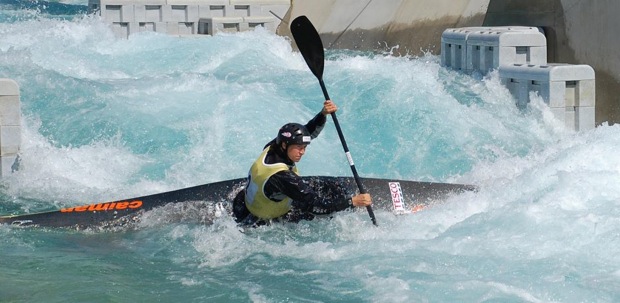
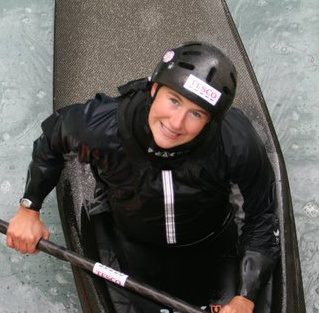
Interview with one of Great Britain's top athletes Lizzie Neave who won bronze at the 2009 Worlds in La Seu d'Urgell in Spain and bronze at the 2011 European Championships, also in La Seu d'Urgell, Spain.
How did you first become involved in canoe slalom?
My dad’s a coach so I pretty much grew up on a river bank and he made sure that I was going to pick it up at some point. I would say that it is probably not the easiest sport to get involved in because it is not that well known, so most people that do it tend to have a family link or are from a particular area where canoeing is popular.
 How often do you train and what does it involve?
On average between about ten and twelve times a week so it’s fairly intense. I do about three gym sessions and then the rest on the water either doing technique or physical training.
Which muscle groups does canoe slalom use?
Arms and shoulders mainly but it also uses quite a lot of your core muscles because you have to have a connection from your arms to the boat. You need all over body strength really.
Do you follow a particular diet or nutrition plan? Do you receive advice on this from anyone?
I see nutritionists and try to stick to a healthy diet because I don’t want too much excess weight in the boat because the sport involves a lot of movement.
I have quite a high protein diet because canoeing is a powerful sport and being strong is an advantage.
What is it that you particularly love about it?
I just find it really exciting. Paddling on water gives you a good adrenaline rush and it’s just something different. I find other sports a bit boring; in canoeing the water is always changing, rather than other sports where you you maybe just running in a straight line or swimming in a straight line.
You are adapting to what the water is doing and it just keeps you on your toes and importantly keeps you interested.
Do you mainly paddle on man made or natural courses?
It varies but there seems to be a lot more man made courses out there nowadays. I don’t really have a favourite but just paddling on a variety of waters keeps it fun.
Do you ever get scared? Is it a dangerous sport?
When I was younger I used to get scared and yes it can potentially be dangerous if you don’t know what you are doing, but as long as you are confident enough on the water then it’s really quite safe.
What are your strategies to cope with the fear?
I have just learned to cope because I know what it’s going to be like and I have got a lot of experience on the water to be able to handle it in the right way.
What does it mean to you and your sport to have the Olympics coming to London in 2012?
I think it will be really good to be competing in front of a home crowd and I think it will make winning even better because of everyone supporting you from your home nation.
How do you plan to prepare for the Olympics? What do you hope to achieve?
I think in the first place, to be there would be a really good achievement because in canoe slalom there is actually only one place available for the girls, so basically I would have to be the best in Britain. If I did make it, then I would hope that I would be a strong contender for a medal.
 How do you stay motivated?
I think realising that my hard work in training is paying off.
I get to travel all over the world too. And just success really; success next year will make we want to train more and I think because canoe slalom is quite an exciting sport the training itself isn’t always hard work and boring – it can be a lot of fun at times.
Who do you admire in the sports world?
I don’t really have any heroes but I think a lot of people are very dedicated and work very hard. Like David Torrance, he won a silver medal at the Olympics this year and just seeing him train, his work ethic is amazing and it makes you think that if I trained like him then maybe I could achieve something like that. Seeing him have success makes me want to keep training.
If you could improve one part of your sport what would it be?
To have more media coverage and publicity to improve the profile of it. Because it is quite a low profile sport, the funding isn’t all that great and because people don’t really know about it we don’t tend to get many sponsors.
What advice would you give to someone thinking of becoming involved in the sport?
The best place to start is to look at the BCU website, they have a list of clubs, so find a club near to you and go from there.
What would you say are the positive aspects for you of being involved in sport?
It gives me a purpose in my life, something to go out and work hard for and I want to be successful at it.