 M. DAWSON
 J. CLARKE
 M. SMOLEN
 E. FER
 C. KUHNLE
 M. CHOURRAUT
 M. BENUS
 F. ANTON
 L. BOZIC
 K. HOSKOVA
 J. FOX
 BREZINSKI/BREZINSKI

 A. PETERS
 V. KHUDZENKA
 E. MEDVECKZKY
 GRIJIC/NOVAKOVIC
 L. QIANG
 M. DE JONGE
 R. POULSEN
 A. CHERVOVA
 S. TARNOVSCHI

 J. MOCKE
 E. LEVEMYR
 S. RAFAEL
 H. TAKAKU

 M. GRAZIANI
 J. EGAN
 N. LJUBEK
 MINDE/HAMAR
 PINTA/MOZZICAFI
 S. LAMMLER
 A. BUSLAIEVA
 M. WEGMAN
 S. REINOSO
Jonathan Males reflects on the recent ICF Congress
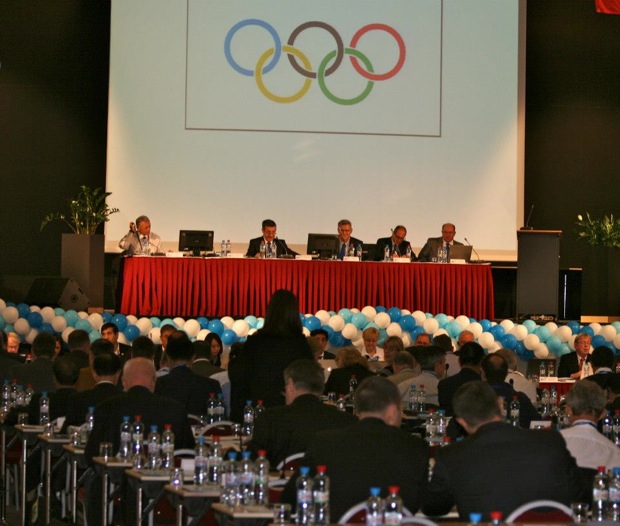
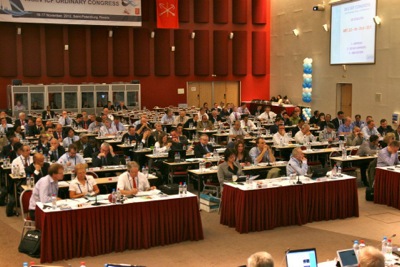
Jonathan Males | Performance1 - The recent ICF Congress in St Petersburg marks another chapter in the on-going push for gender equality in canoe-sport. The immediate aftermath to the congress has been described as a ‘global outrage’ – prompting an explanatory statement from ICF President Jose Perurena re-affirming the ICF’s commitment to pursuing gender equality and keeping open the prospect of Women’s canoe events in Rio 2016 – albeit within the same overall athlete quota.
I’ve been asked by SPORTSCENE to offer some reflections, which I do with some provisos. I’ve never been to an ICF Congress and over the years I’ve only ever taken a sporadic interest in the high level politics of our sport. My observations are based on publicly available material – so I’m sure I’ll miss many of the subtleties of ICF politics. Finally, although I’m trying to take an objective view I know a handful of the key players, and as a father with several paddling daughters I have my own bias about women in canoeing!
So let’s begin by trying to unpack what happened at the Congress and place it in a broader context.
Vice President election
A significant component to the negative reaction to the Congress was Richard Fox not gaining re-election as ICF 2nd Vice President. There were eight roles up for re-election at the Congress, and only two were contested, the Vice President and the Chair of the Wildwater Committee. The sitting representative was retained in seven of the eight elections. So it’s an unusual situation not to be re-elected – and no doubt disappointing for Richard. It was a secret ballot, so there’s no way to know how the voting went other than to say that Joao da Costa Alegre of Sao Tome Principe got 52 votes and Richard Fox got 40. The people who voted are the delegates from each national canoe federation, and there was speculation on the ICF news that “Da Costa Alegre may have benefitted from votes from the African, Asian and American continents, who are eager to have stronger continental representation on the ICF Executive Committee”.
 Delegates faced a choice of two very different candidates: one a naturalized Australian bringing firsthand experience from the top echelons of the sport, the other an African bringing an established political network operating at a continental level.
The sitting Vice President was Richard Fox, five time world champion, experienced as an Olympic coach and National Performance Director. He represented the ICF in negotiations to include slalom in Sydney 2000 and is an influential figure in the slalom world. And father to Jess Fox, Olympic silver medalist, accomplished C1 and K1 paddler and a rising star in the slalom world. Fox is widely considered to be a progressive voice for change in the ICF, including pushing strongly for the inclusion of women’s canoe events.
Standing against him was Joao Manueal Da Costa Alegre. Educated in Cuba and France, Da Costa Alegre represents Sao Tome and Principe on the ICF (if like me you don’t know where this is, it’s one of the smallest countries in Africa and comprises a couple of small islands in the Gulf of Guinea). Da Costa Alegre has a long background in sport education and sport politics, holding roles such as President of the Olympic Committee of Sao Tome and Principe, President of the Confederation Africaine de Canoe, and Vice President of Association of African Olympic committees. His three-page election manifesto promised to make canoeing a ‘universal sport for all’ and to ‘promote activities for women.’
So for all the disappointment expressed on Facebook and Twitter, a majority of the National Federation delegates apparently believed their interests would be better represented by Mr Da Costa Alegre than by Mr Fox.
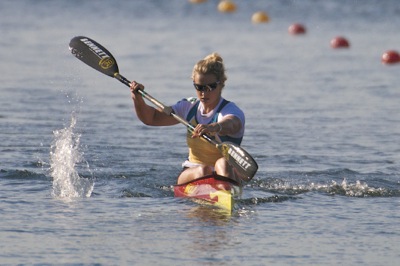 Rather than framing this election result as a ‘blow for progress’, I wonder is this simply a reflection of the complexity and changing needs within a global sport? To retain credibility with the International Olympic Committee, the ICF has had to make serious efforts to develop the sport beyond its Western European and North American origins. The ICF Development Programme gives useful insight into the activities and investment – some 680 000 euros over three years, including a specific women’s canoe initiative (http://www.icfcongress.com/wp-content/uploads/2012/08/ICF-Development-Proposal-Oct2012.pdf). The interests of a developing country are likely to be to establish and nurture the sport at a ‘grass roots’ level. I would guess that the question of which classes and how many women compete at the Olympics would be further down the agenda than for those countries with an established competitive presence.
The ICF Congress gives one vote per nation, whether that nation is a canoeing powerhouse like Germany or a tiny newcomer like Kiribati. This means that by pushing to develop the sport more evenly around the world, so too is political power becoming more widely dispersed. I would love to see a graph that shows which national federations voted at recent ICF congresses – my guess is that the overall number of nations has increased with the growth coming from the developing world. So taken at face value, the election of an African representative to a senior ICF role can be seen as an important step in canoeing becoming a truly global sport and the ICF becoming a global sporting body. Whether this is also a sign of more conservative forces at work remains to be seen, and I don’t know to what extent this can be interpreted as a snub to Richard or the initiatives he championed over the last four years.
Women’s canoe
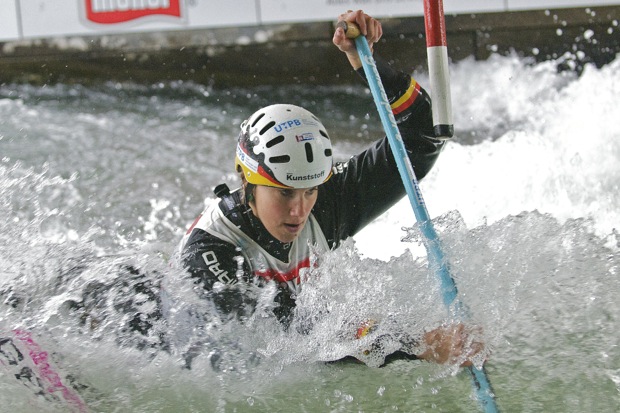
The other big issue at St Petersburg, and one that has been linked in the media to the Vice Presidential election is that of gender equality, specifically the inclusion of women’s canoe events on the Olympic programme. Reading the material on the ICF website, I noticed that this issue gets plenty of prominence and that “The goal remains to have an equal number of women and men’s medals at the 2020 and/or 2024 Olympic Games.” Critics argue that this is only lip-service, and I can see how this time-frame feels a long way off, and a little vague, for those women canoe paddlers who are now training hard with Rio in their sights.
Many competing interests underlie the ICF’s simple aspiration. If the inclusion of women’s canoe events in Rio can only take place within the same athlete quota of 330, then which events will go? I’ve seen a suggestion for a balanced number sprint programme of men’s and women’s K1, K2, C1 and C2 over 200 m and 1000 m, but this would mean losing K4 events. Given that the ICF Sprint committee recommended no change to the Rio programme, I don’t know if there’s the political will for such a radical change from within the sprint community itself. There seems to be more impetus from within the slalom community for the inclusion of women’s C1 at the Olympic, but this still leaves the question of how to make the space. Does the ICF have the political will to tackle the basic question of athlete quotas with the IOC? Or would this get a bit embarrassing when considering the respective balance of spectator numbers and television audiences for sprint and slalom?
Supporters of women’s canoe events argue that it’s a basic issue of fairness, and that there should be equality of opportunity for men and women in our sport. Hard to argue against that, but others respond that this is a debate about quality not equality. They say that until there’s sufficient depth and breadth of ability it doesn’t make sense to allocate scarce resources (i.e. Olympic places) to women’s canoe. The retort is that the single most powerful way of ensuring resources and a depth of field is to include women’s canoe on the Olympic programme. This is a classic ‘chicken and egg’ argument that can circle endlessly. Should standards be high enough before Olympic competition or is it only possible to get the standards up once there’s the certainty of the event being in the Olympics?
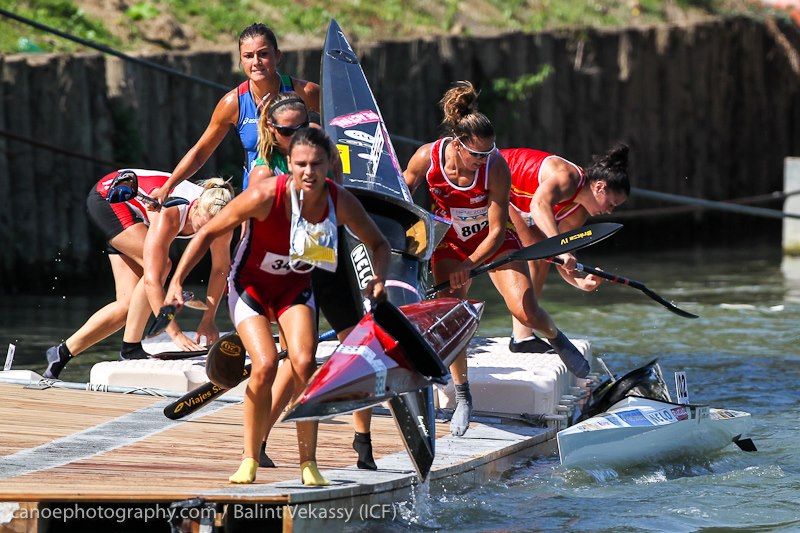
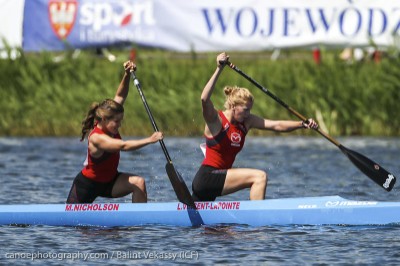
So we have the ICF investing in initiatives to get more women involved in the sport around the world. Women are training hard and competing in sprint and slalom canoe events, with a steady increase in numbers and standards. They are also increasingly willing to speak out – for example British canoeist Samantha Rippington made the news in the summer when she launched a High Court challenge against LOCOG for failing to carry out an equalities audit. Both the IOC and LOCOG ducked and dived in response, claiming they weren’t subject to the Equalities Act 2010 (UK). LOCOG also pointed out that for the first time, every country had women competitors at London 2012. All in all there is a growing, and I believe unstoppable, momentum for change that will eventually lead to full and equal participation by women in our sport – yet the pace of change is frustratingly slow for those who are investing their lives and passion in this cause.
Conclusion
It’s never easy to bring about change, especially when it involves challenging people’s vested or competing interests. The ICF brings together people who at least claim to share a common interest in canoe sport yet who also have widely divergent cultural backgrounds, different access to resources, different personal agendas and pressures. There’s a rule of thumb that says in any organisation, 20% of people will be supportive of change, 60% will be undecided and open to persuasion, and 20% will be against the change no matter what. So the key is to address the needs of the 60% and get them onside – pretty much ignoring the 20% who will always be resistant. Those with a closer view than me could probably advise on how this applies to the ICF! It would be fascinating to hear from a range of ICF delegates to understand more about their view of the canoeing world and what they see as the priorities.
 The Chinese communist leader Zhou Enlai was once asked what significance he gave to the French Revolution in 1789. “It’s too soon to say” was his enigmatic response. What’s clear to me is that the same applies to last week’s ICF Congress. The full impact of the decisions made – or not made – at the Congress will only be known in years to come. In the meantime, I wish the very best to all those people who are working towards the best interests of women and men in our sport – it’s not easy!
JONATHAN MALES competed on the Australian slalom team in the 1980’s and worked as a coach and sport psychologist with Great Britain slalom and sprint team from 1993 to 2005. He is an active paddler in slalom, freestyle and whitewater touring. His company Performance1 (www.performance-1.co.uk, Twitter: @P1ltd) helps business leaders and is based in London.
Gender equality in women’s canoeing: links to media
Download ICF Press Release - ICF Clarifies Position on Women's Canoe Category and Gender Equity (20.11.2012) below.
