 M. DAWSON
 J. CLARKE
 M. SMOLEN
 E. FER
 C. KUHNLE
 M. CHOURRAUT
 M. BENUS
 F. ANTON
 L. BOZIC
 K. HOSKOVA
 J. FOX
 BREZINSKI/BREZINSKI

 A. PETERS
 V. KHUDZENKA
 E. MEDVECKZKY
 GRIJIC/NOVAKOVIC
 L. QIANG
 M. DE JONGE
 R. POULSEN
 A. CHERVOVA
 S. TARNOVSCHI

 J. MOCKE
 E. LEVEMYR
 S. RAFAEL
 H. TAKAKU

 M. GRAZIANI
 J. EGAN
 N. LJUBEK
 MINDE/HAMAR
 PINTA/MOZZICAFI
 S. LAMMLER
 A. BUSLAIEVA
 M. WEGMAN
 S. REINOSO
Safari: Preview 42nd Amsterdam Waterland Marathon and Edwin de Nijs interview
Organiser and retired twice European Champion Edwin de Nijs provides an insight into what we can expect at this year's distance paddle in Amsterdam as well as a glimpse into his own paddling hay-days.
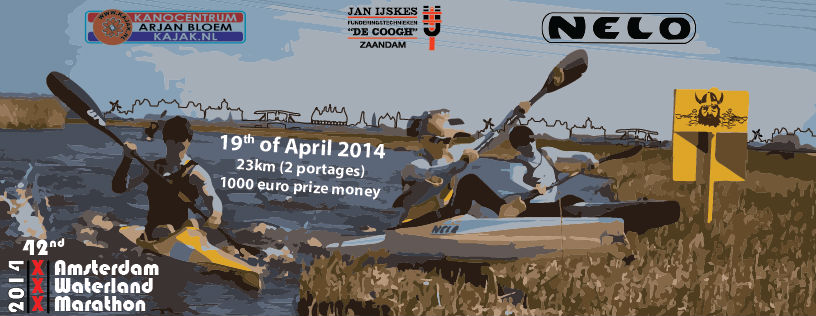

Nick Harding | @nickhdg | Sportscene - Edwin still holds the record for the most number of Waterland Marathon wins. One of the most acclaimed Dutch paddlers ever, he competed at almost every marathon World Championship from 1992 to 2006 earning a Silver in K2 in 2002 and a Bronze in K1 in 1999 – his WC medal was what was behind him being voted as '2002 Amsterdam Sportsman of the Year'. Edwin won the Europeans in K1 both in Spain 1995 and in Italy 1997 plus a Bronze medal in K2 in 2001. He is part of a team of 3 including Rens Janssen and Robert Gerritsen who are organising the event.
2014 Preview
Forecast: the best ever and hardest Amsterdam marathon to date.
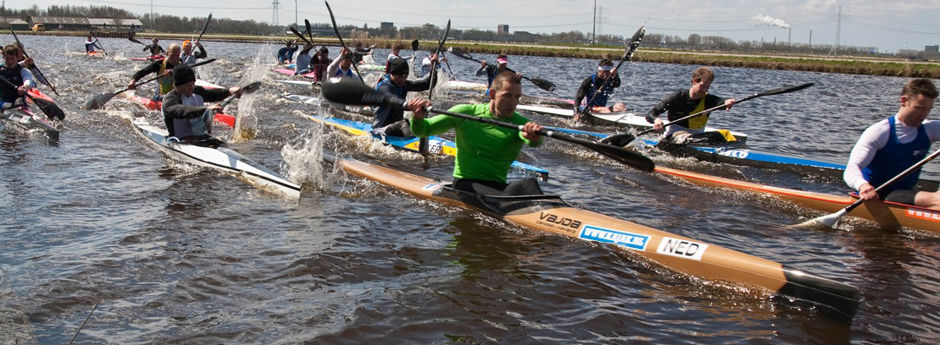
'Safari'; countryside grass, high reeds, Dutch windmills and cows a plenty! The 42nd annual marathon in Dutch honey-pot Amsterdam boasts: 6 race classes (K1 Senior Men/Women, K1 Veterans Men/Women and K1 Junior Boys/Girls), 70 plus competitors, 14 nationalities represented in all classes (increasing day by day), 1000 Euros prize money and 23km of technically-challenging racing on varied types of water along iconic waterways – some might say you are paddling the very arteries that feed a living, breathing city.
Last year's men's marathon was won by Dutchman Joep van Bakel following a three-year absence of any 'Nederlander' being on the podium, it was Swede Emma Andersson who secured victory in the women's race over rival Dane Annemia Pretzmann.

Of course Edwin would love to see another Dutch winner, male or female, but this year strong challengers lurk. Forget 'Game of Thrones', an invasion is coming from Southern Europe while another flotilla sets sail from the other side of the English Channel...
An armada sails North up the Bay of Biscay loaded with Nelo boats, 4 title-winning Spanish conquistadors are on-board, sharpening their blades, on the warpath they look to upset Dutch dreams. Captained by Manuel Busto Fernández (Edwin's nemesis who stole his record finishing time with 1hr 40.20 with such disdain in 2011 - “I will never forgive him for that!”), the retired 10-time marathon World Champion and 5-time European Champion competes once again in the 'Low Countries'. First-mate is 2013 K1 World Champion Ivan Alonso, he is also K2 World/European Champion with compatriot Emilio Merchan who also sails direction Amsterdam. Not just a young deckhand, Alejandro Sanches is 2013 U23 European Champion and he is set to make upsetting waves for his fellow countrymen under orange banners.
Drumbeats bellow as 15 sailors of the British Canoe Union development squad also make hast for the Dutch capital under King Willem-Alexander's rule – major players in the Junior races? Britain's Tim Pendle finished in close second in the Senior Men's race last year and could be looking to go one better.
What a show it would be to have some of the international younger talent right up amongst the big names of experience. We can't rule out the Hungarians either! Edwin was cagey in his interview about naming favourites for the win as it's really tough to predict this year but we can't help feel that the podium will bare Spanish colours, as for who, it is wide open.
The starting list this year sets up for some really bunched up racing, none of this paddling the whole course on your own, we expect lots of paddling in groups across different ability-levels.
Course

Year on year feedback from competitors is excellent because this 'classic' and typically Dutch race offers something different from modern marathons. Conditions are unpredictable with either April showers, wind and temperatures of about 8°C, or in fact clear sunny skies with anything from 18-22°C.
It's not only the weather that can really impact on the outcome of the race, but the varied types of water along the course: wide and narrow channels, deep and shallow 'polder' ditches, plus open harbour mouth just after the first portage at Monnickendam – participants must negotiate a tricky lock here.
Each of these types of water require different stamina, power, patience and technical competence (of which I'm embargoed from talking about to keep the race fair!)
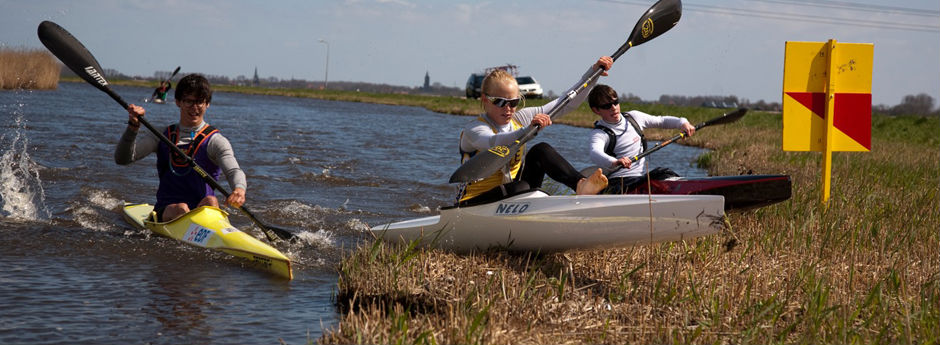
From Monnickendam (the ladies' start) it is on to the second portage at Ilpendam which is one of the most unique get-outs in the world as paddlers must glide onto the river bank to brave grassy marshland (and the odd cow) over a 500m sprint.
The distance paddle then continues Northbound where the right-hand finish is a stone-through from the doors of the Viking Canoe Association – Edwin's first and last club.
Edwin and co. have developed strong relationships with local authorities over the years to ensure permission is granted for temporary land use. Recently the last 5km of channel has been modified; steel now lines the canal walls provoking a safety issue – therefore this year, and for the second time, safety boats will shadow paddlers throughout the duration of the race plus an extended force of volunteers and marshals will be present.
The course does pass through some private farmland, a little bit of bribery was needed to get round the local wildlife: “We solved this problem by giving him [the farmer] a bottle of whiskey, so every year he's happy! Two days before he takes the sheep off the land, then the kayakers are free to use it!”
Waterland's ethos and its future
The intention behind the Amsterdam Waterland Marathon is to give young and future world champions the opportunity to compete against those at the top of their game. Having more elite paddlers race is only one element to its ongoing strategy, it's also about promoting local legacy, Amsterdam tourism and Dutch culture; hence why all competitors will receive a night-tour of the city on the Saturday night after the event.
Edwin and his team would like to put Waterland clearly back on racing calender, positively the marathon is ever gaining more recognition. A lot of the athletes Edwin competed against are still paddling today which helps greatly with its promotion (unfortunately Edwin has had to hang up his paddle nowadays due to work and family commitments, undeniably he misses the rush of competition though!).
The future of the event could see the introduction of canoe races – this year there were 2 Czech competitors interested in racing C1; they were given permission to compete against the kayaks, but were advised that they were the only 2 doing so, yet they were also advised that “you have to start somewhere!” The pair sadly withdrew, probably because the competitive edge in a field of 2 would not have been the same. However, this is a very promising sign as it shows there is scope to develop such opportunities as well as interest out there from athletes.
At Waterland men currently race 22km and women 14km – in line with 'classic marathon' traditions. Edwin was very much open to the idea of perhaps making the distances equal for both genders: “I'm one of these people who would rather see one start-line and one finish-line; equal for everybody. Internationally it's still normal that the women do a shorter course than the men, and also for the juniors. I think it should be ok if everybody does the same as it's only 23km, it's not that long, a lot of people should be able to do that within two hours. We are working on that, but for now we are keeping to tradition.”
As for marathon racing perhaps one day being included in the Olympic programme he said:
“I don't think it will add anything to the sport. If you have a look at a lot of sports, the Olympics is not as hard as the selection a year before. Some sports bring themselves down just to be in the Games, like in sprint I think the World Championships are tougher than the Olympics.
Changing the basic elements of a sport just so it is on a Olympic podium is not the right thing. The first rule in marathon racing is: 'the competitor has to take the water as he finds it'. Over the last few years the ICF has been changing their view on this one. Similar courses are being set every year with the same laps, the same basic portages, there is not much room for the athlete to make tactical decisions, when every 200m there is a buoy in the water that guides you through the course.
If a sport has to adjust itself like this just to be in the Olympics it is not worth it. If marathon can retain its basic elements then it will be good to be part of such a great podium. To maintain and upgrade these values, it’s important to have at least two athletes per country for competition and opportunity – then you get big completion around the world!
Marathon racing should be more like road cycling – with different courses to give different types of athletes a chance to win; 'The ICF Classic Series' is the best example of races with these ingredients, like Decenso Riba del Sella in Spain and the famous Fish River marathon in South Africa.”
Thanks to Edwin for his insight, we eagerly look forward to the ferocious Dutch-Spanish duel on April 19th. To finish here's what he had to say about his own career highlights and demons:
Worst memory
Going for his third European Championship in 1997 in Poland:
“Never have I felt so strong as I did in that race where I dominated from start until 2km before the finish-line – that was the portage. I took my boat out, I never make mistakes with portages! At that moment a little bit of water came into my boat, the back rudder hit the concrete and went right through the back of the boat. To feel that nobody could beat was awful.”

Career highlight
Winning his first European Championship in 1995 in Murcia, Spain. This was also the first time he beat his rival, the much more experienced (at the time) Dutch great Tonny Benschop who finished second – Edwin was lighter; this served him on well on the large volume of water present that day.
More information about Waterland
- Organisers: Edwin de Nijs, Rens Janssen, Robert Gerritsen, Viking Kajak Club and 20 volunteers.
- Sponsors: Funderingstechnieken De Coogh (the company Edwin works for), Kajak Centrum Arjan Bloem (Edwin's private sponsor for 15 years when he was racing), City of Amsterdam.
- Official supplier: Nelo
- Race footage and video news flash: Gijs van Wijk (Sportscene Intern)
Links
- Site: amsterdamcanoemarathon.com
- Viking Canoe Association: www.kvviking.nl