 M. DAWSON
 J. CLARKE
 M. SMOLEN
 E. FER
 C. KUHNLE
 M. CHOURRAUT
 M. BENUS
 F. ANTON
 L. BOZIC
 K. HOSKOVA
 J. FOX
 BREZINSKI/BREZINSKI

 A. PETERS
 V. KHUDZENKA
 E. MEDVECKZKY
 GRIJIC/NOVAKOVIC
 L. QIANG
 M. DE JONGE
 R. POULSEN
 A. CHERVOVA
 S. TARNOVSCHI

 J. MOCKE
 E. LEVEMYR
 S. RAFAEL
 H. TAKAKU

 M. GRAZIANI
 J. EGAN
 N. LJUBEK
 MINDE/HAMAR
 PINTA/MOZZICAFI
 S. LAMMLER
 A. BUSLAIEVA
 M. WEGMAN
 S. REINOSO
ICF pushes Canadian canoeing in South Africa
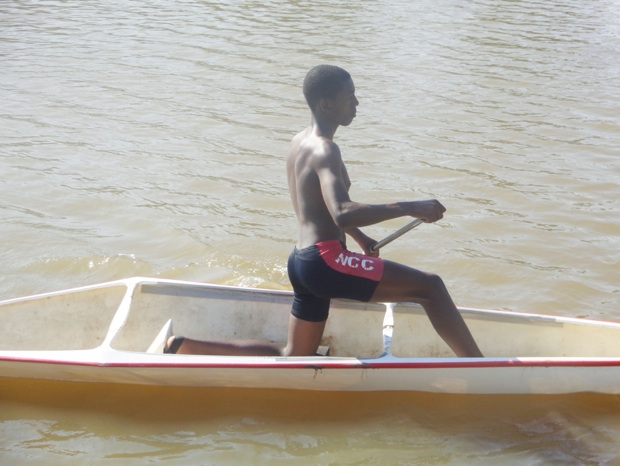
Khumbulani Molefe, from the Natal Canoe Club, in a C1 boat.
Brad Morgan - Fresh off the success of Team South Africa at the International Canoeing Federation (ICF) Canoe Marathon World Championships in Oklahoma City in September, where the men's kayak team claimed the world number one ranking, Canoeing South Africa (CSA), together with the ICF, is making a push to popularise Canadian canoeing.
Canadian canoeing, in which paddlers have one knee on the floor of the canoe and a paddle which is used to only one side of the craft, is a relatively unexplored avenue for South Africans, but it is slowly gaining some traction as efforts to support its development are being made.
CSA General Manager Colin Simpkins said the push has something to do with a host of continental and World Cup events that will be hosted by South Africa over the next three years, culminating in the ICF Canoe Marathon World Championships in 2017. The events are scheduled to take place at Natal Canoe Club (NCC) in Pietermaritzburg as it builds up to the World Champs.
The ICF, though, has been the primary driver of the discipline. "They're offering coaching, and we flew two guys to Morocco earlier in the year, Philip van Tonder and Sam Phungula. Now they have sent someone out here to help build up the C1 [Canadian singles canoeing]," Simpkins explained.
 That someone is the Hungarian Canoe Federation's Gabor Szalay (pictured left), who won national titles in C1, C2 and C4 competition, and also claimed a bronze medal at the World Championships. Szalay, who helped Vietnam prepare for the 2013 South East Asian Championships, is hosting two two-week long coaching events, at NCC and in Johannesburg.
"The ICF would like to see a big entry for the World Championships and World Cups, and South Africa hasn't got a specialist canoeing team for Canadian canoeing. I would like to show them how to prepare for the competition, teach them techniques, how to use the equipment and more," he said.
"I would like to teach them how to be competitive at the World Marathon Championships."
Szalay's work includes coaching coaches, while he will be exploring the development ranks to unearth talent to compete in Canadian canoeing.
CSA General Manager Colin Simpkins said it would take some time for the discipline to make inroads.
"I think it is going to be difficult, but if we can foster this and build it up we will have more guys taking part, especially on the development side," he said. "We will have more guys eligible for national teams. Hopefully we'll expand the discipline. It will be a bit of an uphill battle in this country where most of the enjoyment comes out of paddling in rivers, and you can't paddle C1s in rivers. They're flat-water boats."
One thing Simpkins has on his side is a development programme that is the envy of many other sports. There is a good reason for this, he explained: "Our development wasn't a knee-jerk reaction to democracy. We were involved in that long before 1994. We were encouraging people from disadvantaged communities to be a part of our sport, so when democracy did arrive it was a catalyst to improve what we were doing already."
The early focus of the Canadian canoeing expansion will be on sprinting, but marathons will also be explored, with paddlers often able to translate the skills of one to the other.
NCC General Manager Brett Austen Smith, the man behind South Africa's successful bid for the 2017 ICF Canoe Marathon World Championships, said the Canadian canoeing courses will take matters step by step to develop potential in the right way. "We're starting from the basics. We're interested in getting the programme going. Gabor's come out to give us some very practical advice on the basic stuff," he said.
Looking ahead, he added: "In 2017 [at the World Championships], my goal is to have two representatives in the seniors, under-23s and juniors."
Szalay warned hard work lies ahead for the South African paddlers who are taking on Canadian canoeing.
"Canoeing is not an easy sport because you need to maintain a good balance. You need a lot of power and endurance. You need to sleep enough, eat healthily, you should avoid cigarettes and alcohol, and you should train as well as you possibly can, to your maximum ability every session," he said.