
 M. DAWSON
 J. CLARKE
 M. SMOLEN
 E. FER
 C. KUHNLE
 M. CHOURRAUT
 M. BENUS
 F. ANTON
 L. BOZIC
 K. HOSKOVA
 J. FOX
 BREZINSKI/BREZINSKI

 A. PETERS
 V. KHUDZENKA
 E. MEDVECKZKY
 GRIJIC/NOVAKOVIC
 L. QIANG
 M. DE JONGE
 R. POULSEN
 A. CHERVOVA
 S. TARNOVSCHI

 J. MOCKE
 E. LEVEMYR
 S. RAFAEL
 H. TAKAKU

 M. GRAZIANI
 J. EGAN
 N. LJUBEK
 MINDE/HAMAR
 PINTA/MOZZICAFI
 S. LAMMLER
 A. BUSLAIEVA
 M. WEGMAN
 S. REINOSO
Preview Nanjing Youth Olympic Games
Michael Noyelle | ICF - Thirty-four men and 30 women canoe-kayakers will start making waves when their competition begins at the Nanjing Rowing-Canoeing School at the 2nd Youth Olympic Games, Nanjing, on Saturday, 23 August.
Eight gold medals will be up for grabs in four different canoe (C1) and kayak (K1) categories in men’s and women’s events; K1/C1 head to head canoe sprint and K1/C1 obstacle slalom.
Head to head canoe sprint
The 2013 junior canoe sprint world championship in Welland, Canada, was the qualifying event. The format remains the same as Singapore 2010, but new for these competitors. They normally sprint in a straight line in distances from 200m to 1000m. In keeping with the IOC sports innovation push, the ICF have set a specific format for the Youth Olympic Games to make the competition different for the athletes.
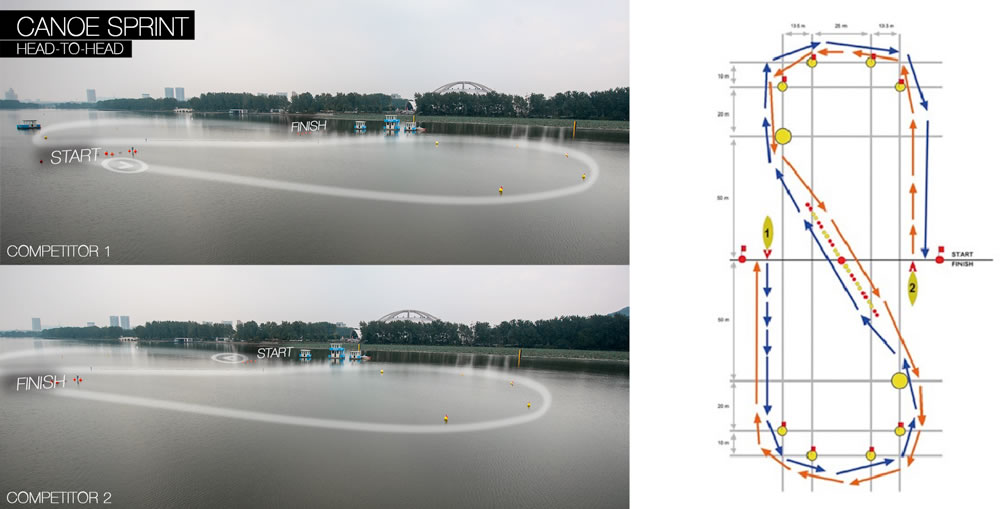
The canoe sprint takes place on a 420m-long, figure-eight shaped course. Two athletes start at the same time, at the same starting line but in opposite directions. Winners will be determined by a progressive system, different from Singapore 2010 which used a knockout format. The progressive system is based on time or winning a race depending on the phase of the competition, from qualification heats to the quarterfinal final and then head to head knock out onwards. Obstacle slalom will also use this system.
Athletes must follow a course bouys throughout the course and manoeuvre their boat around the outside while staying in their lane. Their bodies, paddle and boat can touch the rope or buoy but it cannot go inside the buoy or go on the wrong side of the course. They can correct any wrong navigation by paddling back and returning the correct way. A competitor can be disqualified if he or she fails to correct a mistake or if the boat capsizes.
An athlete who qualified for the sprint events must also compete in the slalom event and vice-versa.
Obstacle slalom
The 2013 junior slalom world championships in Liptovsky Mikulas, Slovakia, was the qualifying event. The format is the same as Singapore with the exception of an Eskimo roll in the middle of the course. But, like the sprint, it is a different from the format that is the norm. The inclusion of the women’s C1/K1 obstacle slalom is also new to Nanjing 2014.
There are two parallel courses on a flatwater surface instead of the usual rapids. The course is 50m long in one direction and there are four pairs of buoys on each course rather than gates. Starting at the same time and in the same direction, the athletes must negotiate the buoys up the course and then return to the starting line.
Website: www.nanjing2014.org/en/