
 M. DAWSON
 J. CLARKE
 M. SMOLEN
 E. FER
 C. KUHNLE
 M. CHOURRAUT
 M. BENUS
 F. ANTON
 L. BOZIC
 K. HOSKOVA
 J. FOX
 BREZINSKI/BREZINSKI

 A. PETERS
 V. KHUDZENKA
 E. MEDVECKZKY
 GRIJIC/NOVAKOVIC
 L. QIANG
 M. DE JONGE
 R. POULSEN
 A. CHERVOVA
 S. TARNOVSCHI

 J. MOCKE
 E. LEVEMYR
 S. RAFAEL
 H. TAKAKU

 M. GRAZIANI
 J. EGAN
 N. LJUBEK
 MINDE/HAMAR
 PINTA/MOZZICAFI
 S. LAMMLER
 A. BUSLAIEVA
 M. WEGMAN
 S. REINOSO
K4 wins first gold ever for Kazakhstan at the 2014 Asian Games: next step Rio!
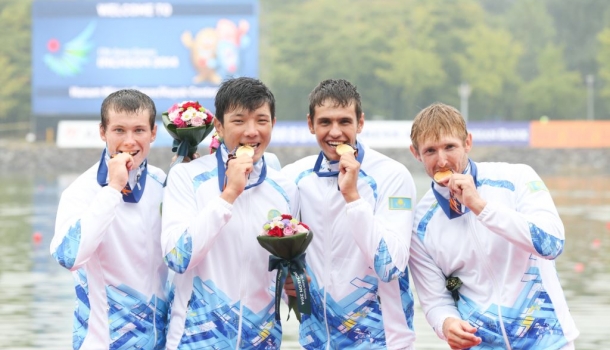
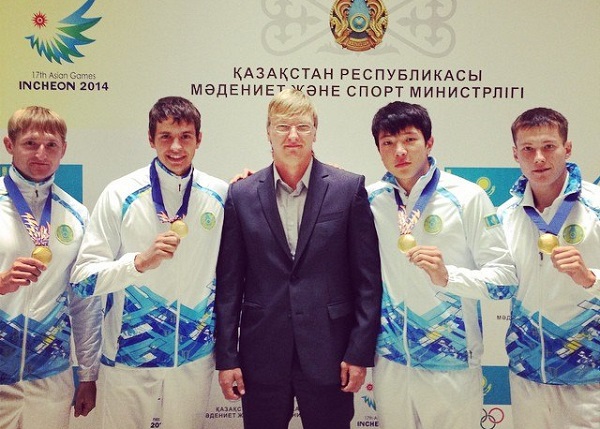
Source: SK Sport | Translation: Anton Knesis | Proofreader: Katie Ellis - Ilya Golenda, Daulet Sultanbekov and Andrey Erguchev are three quarters of a Kazakh K4 team who have all just turned 20. They are considered heroes of their team as they have won Kazakhstan’s first kayaking gold medal at the Asian Games. Joining these three young athletes is the experienced competitor Alexander Emelyanov, who has experience of winning medals at the Asian Games and is 10 years older than his teammates.
These newly crowned champions have only been competing for two years but are already making their mark in the senior categories. Together with another kayaker Yuri Berezintsevym they won the student world championships. They have also been bronze medalists in Asia and recently placed eighth in the Moscow sprint world Championships. The young paddlers admit that the secret of their success lies in their strong friendship which began when they were all youngsters. In the following interview by sk-sport.kz, we learn more about their journey to becoming professional athletes, the role of their coach and to what extent their recent wins have changed their lives.
Guys, This is the first time you have competed in such a major international tournament. What were your impressions of the event?
- Of course, we were very happy to be there. We were extremely glad to have brought home the first gold medal for Kazakh kayaks in this particular discipline and distance. The realisation that we were the champions did not hit home immediately, it only sunk in finally after about five days. When all our relatives congratulated us, it was then that we finally felt we had won. We enjoyed our experience in Korea. It was a great race and we had a great start. There were always going to be some difficulties, but we managed to overcome them. We are completely lost for the words at the moment, we’re a bit emotionally overwhelmed. I’m sure that the moment we won will stay in our memories forever.
A month before the Asian Games you were crowned World Student Champions. Would you consider this the start of your professional sports career?
- Yeah, I guess we would. We had a good benchmark at this event for the World Cup and Asian Games – we used the Student world championships as an indicator for these events. We now have something to fight for and something to work on. We will be pushing and supporting each other. I hope our k4 team will last as long as possible. Three of us have known each other since childhood, we have been through a lot together and we have become like each other's family. It also helps that Alexander Emelyanov is older and more experienced.
As it happens, Ilya and Daulet have known each other since 2007. According to Daulet, he and Ilya have always been fierce rivals on the water. There was always competition between them as they were chasing the juniors and trying to be on a par with the senior men. On dry land however, they have always been friends. Ilya and Daulet competed in K2 and became junior champions in Kazakhstan, participating in international competitions. Daulet was introduced to Alexander while training with the national team.
Which of your victories are you most pleased with? Bearing in mind that the gold at the World Championships is technically the highest standard…
- No, without doubt winning at the Asian Games was our proudest moment. I think this is because this medal means so much for the country and for us. We have been preparing for the Asian Games all year, and all our training was geared towards this event.
Ilya, why was Yuri Berezintsev placed with Alexander Emelyanov? You won the student world championships at the Asian Games with Alexander Emelyanov.
Ilya answered this difficult question….
- Initially, there were five people in our “quartet,” including Yuri Berezintsev. After analysing the results of our daily training sessions and looking at finances, the coaches chose Alexander Emelyanov. Yuri Berezintsev entered the competition alone and he came away with a very good result. There have been no wins since 1998 in kayaking for our country and he managed to break this trend despite very strong competition from China. This is also a really significant achievement.
What was your reaction to this?
- As you know, our team is like one big family. We always celebrate our victories and we are concerned about each other. At the senior world championship, Alexander was with us when we took eighth place. To have to choose between team mates was not fair. It was like asking us "Who do you love more, your Mum or your Dad?" With this agreement we made a decision. We currently spend about 11 months a year together and I think Jura is happy for us. We were all pleased at our performance in the last competition. We have a very friendly team with no place for jealousy because ultimately we all have a common goal.
It looks from the results like you are already a really strong foursome. The four of you seem like you all understand each other really well. How did you get to this point? How are you preparing for your next competition?
- To be honest, none of us expected to get to the Asian Games. I’m not sure anyone expected this result because we were all comparatively young. How did we achieve this? In a team the main thing is ability to understand. If there are internal problems we listen to each other. Our ship has four captains all at once. No one of us is more or less important than the others therefore we are all equally important. Certainly, we have quarrels and misunderstandings but these are trivial. After any disagreements we try to resolve these together. If we make any mistakes during training then in the next session we work to correct these. Our greatest strength is our friendship. This year we were able to beat the Olympic champions from Australia, who were undefeated before now, as well as some strong German and Polish athletes.
Have you ever wanted to compete individually?
- Let's just say, all of us still have a chance to show ourselves in individual disciplines but the chance to compete in such a successful foursome doesn’t happen very often. As such, there was the option to go for selection in K2 but we decided to stay in our foursome and work harder. This discipline is has a lot of potential and is very challenging.. Also, having four members in our team means we have a lot of fun.
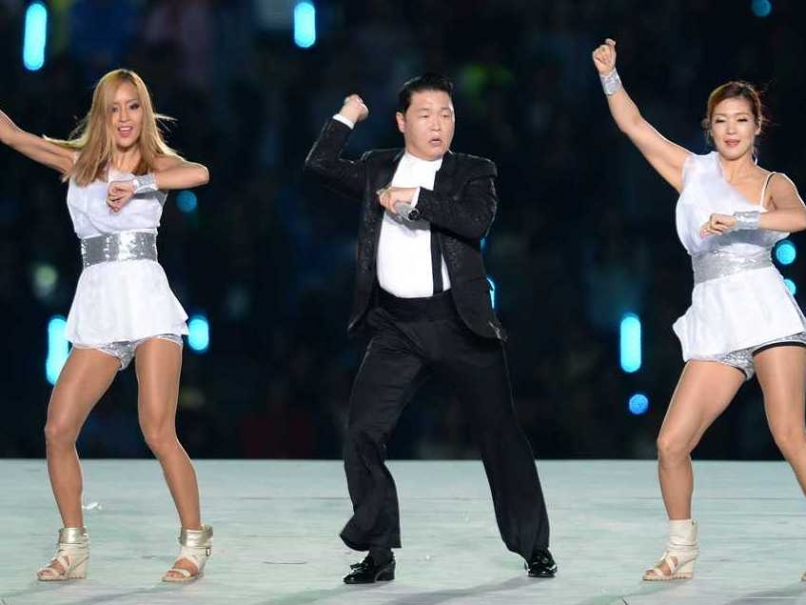
South Korean singer Psy performs during the opening ceremony of the 17th Asian Games in Incheon September 19, 2014
Yes, and there is greater competition in the individual events than among the K4s…..?
- In Asia, we could name four or five teams that are our strongest competitors. At the Asian Championships last year we got third place, losing gold and silver to Iran and Uzbekistan, and not including Asia’s strongest Chinese competitors who did not participate. There are many other similar terms around the world. There is without doubt more competition for winning individual medals, with only about 8 competitive athletes at the top of Asian kayaking. On a global level, getting to a major final is a significant achievement.
Your K4 have already mentioned how grateful you are for your coach, Andrew Shantarovich. How long has he been your coach? Tell us a little about him as your mentor and about how he works.
- In a recent conversation, Shantarovich admitted that he has grown with the team. He is a young coach and each achievement brings him as much joy as it brings us. He took our team on in 2011 at which point we weren’t even training together as a team. We were juniors and in 2012 we (Ilia) with Daulet were selected to join the team, a year later Andrew joined us. In two winter seasons we qualified for the World Cup finals. This is the first time since Kazakh Kayaks was established that we have qualified in an Olympic discipline. At the last Asian Games, there was not a single gold medal for the paddlers, but this year we had five. The results speak for themselves. Of course, we think this is down to our coach and the methods he used to establish a successful, unified team. It is interesting that the vast majority of the team boats consisted of young athletes this year. Our coach believed in us, and we think we hope we haven’t disappointed him. As a person he is very kind and helpful and sometimes he could be considered as our team psychologist. For sure, there are times when he tells us off, but these results wouldn’t have happened if it weren’t for his stern words occasionally.
- “I’m not sure I can speak for you guys, but for me Andrey is like a father” added Daulet.
- He was very supportive when we first started out in our K4. I (Daulet) and Ilya have never competed international arena; other coaches have never taken such a responsibility. They used to say that there was little point in us going because we would only lose. Andrew Shantarovich believed in us. In the first year at the international competitions he never once critised me, nor blamed me. "Kayak for yourself, do it for the experience” he said “and watch the other athletes in race," –our coach’s words helped us mentally. After one year we were showing impressive results. Without doubt, this was down to Andrey’s hard work. The best thing is that we can always have a heart to heart conversation with him. I think we are very lucky to have him as a coach, not everyone can boast such a great mentor.
- Besides our coach we would also like to thank the rowing sports Federation "Kaiykov" for guiding us, and the entrepreneur "Samruk-Kazyna" for sponsorship.
You stepped up to compete at senior level fairly recently. Was this transition difficult to make?
- At the World Youth Championships, the winners of the finals usually qualify for the senior level competitions, so we didn’t notice a huge difference between the standards at these competitions. When you turn 18 you’re no longer a boy and at this age athletes can show impressive results. The main difference was the relative lack of experience we had had as athletes.
After series of big wins your names became more recognisable this year. Now you have fans that come to watch your races and wish you good luck. Do you feel more pressure or a sense of responsibility to your fans?
- After we qualified for the world championships and then won the student world championships, we began hearing that people thought we could take gold in Korea. It was no longer just the staff who worked with us who believed this but now there were others. For example, the athletics coaches said, "We’ve heard about your results, we reckon you could take the win here." We felt that everyone around us was expecting great results. For sure we had doubts "What if ... What if it does not turn out ...?" These thoughts plagued us, but we’d set ourselves this goal and we wanted to reach it through hard work, while putting the negative thoughts to the back of our minds. The main thing was to avoid making mistakes and to perform in the same way as we do during training. At the Asian Games, we didn’t show anything supernatural, this is just how we train, every three days during training we paddle a similar course.
- I was scared too, but not of losing the championship to Chinese or Uzbek athletes. We were confident that we could win but we were afraid of something like a paddle breakage or something else unexpected as it would have been in front of viewers who were watching the competition online” admitted Daulet. - I'm from Taraz city and recently a taxi driver recognized me. The driver looked at me and said, "You're the Kazakh who kayaks!" Of course, after he was so flattering, I feel a responsibility and I want to please our Kazakhstani people.
What is your the next goal?
- The next World Cup in Milan is where qualification for the next Olympic Games will be decided. It is our dream is to go to Rio de Janeiro in 2016 as none of us have ever competed at an Olympic Games. This goal motivates all four of us; it is our ultimate team goal.