
 M. DAWSON
 J. CLARKE
 M. SMOLEN
 E. FER
 C. KUHNLE
 M. CHOURRAUT
 M. BENUS
 F. ANTON
 L. BOZIC
 K. HOSKOVA
 J. FOX
 BREZINSKI/BREZINSKI

 A. PETERS
 V. KHUDZENKA
 E. MEDVECKZKY
 GRIJIC/NOVAKOVIC
 L. QIANG
 M. DE JONGE
 R. POULSEN
 A. CHERVOVA
 S. TARNOVSCHI

 J. MOCKE
 E. LEVEMYR
 S. RAFAEL
 H. TAKAKU

 M. GRAZIANI
 J. EGAN
 N. LJUBEK
 MINDE/HAMAR
 PINTA/MOZZICAFI
 S. LAMMLER
 A. BUSLAIEVA
 M. WEGMAN
 S. REINOSO
Ekaitz Saies: “The journey’s more important than the destination”
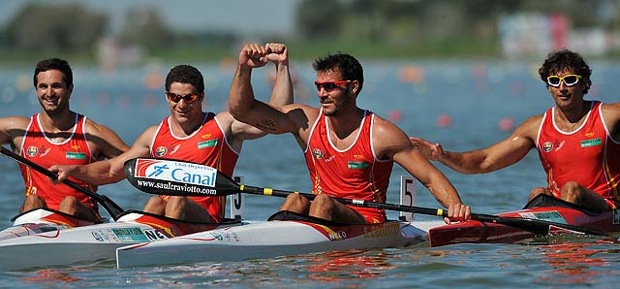
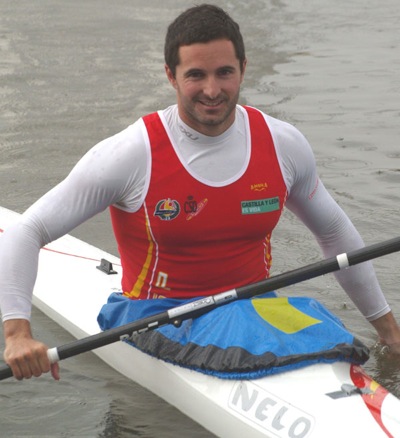
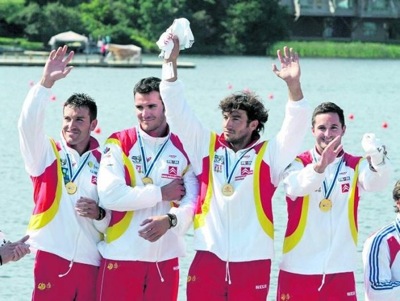
Nick Harding | @nickhdg | Sportscene - Life lessons over a coffee with 2-time K1 4x200m World Champion Ekaitz Saies (above far left) in his home-town San Sebastian, Spain.
Street-side, April sunlight on my face, I'm waiting for a man, by reputation, who is an incredible ambassador for sport, education and positive thinking. “Nick?”, I turn – my Sportscene hat has clearly done the job, it's Ekaitz; not only is he wearing the same red checkered shirt as me, we laugh about our Nelo branding; my hat, his gym bag!
Athlete himself, elite and youth coach, club founder, Phd student in Psychology of Education (specialisation: sport psychology), collaborator for IKERKI Research Group from the University of the Basque Country, and recent-father, Ekaitz was born and bred in the beautiful Basque Country in Northern Spain. A local legend in Donostia-San Sebastian and the surrounding region, his career highlights include:
- World Champion K1 4x200m relay (2009 Dartmouth, 2011 Szeged)
- U23 European Champion K1 500m (2002)
- Bronze, European Championship K1 4x200m relay (2009)
- World Cup bronze K1 200m (2008)
- 6 x Spanish National Champion over 200, 500 and 1000m
- Qualified for the London 2012 Olympic Games
“I have great memories of the first U23 European Championships that I raced and won in the K1 500m when it was still Olympic and the 2 World Championships in the relay were great because I never imagined winning a medal. I was recognised a little bit afterwards back home, but it's not really big sport there [in Spain].”
Ekaitz first competed at international level at the World Championship back in 2006 in Racice. He has just renewed his sponsor-contract as a member of the national team and is looking forward to the next World Championship in Russia later this year in August.
Sometimes you meet people who seem to radiate positivity, Ekaitz is one of them; his passion for paddlesports and his involvement in all areas behind-the-scenes is infectious. A highly-educated, down-to-earth, worldly and humble guy, it is very easy to make conversation with him. I was intrigued to find out what has helped make him the man he is today and how he has dealt with the various challenges he has faced in his life.
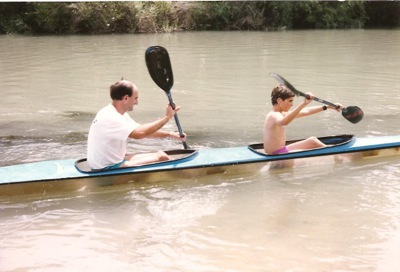 Early clubs and present day coaching
Ekaitz starts by telling me how his father, Joseba Saies (a self-taught leisure paddler, a local pioneer of flatwater sport and current President of the Basque Canoe Federation) got him into kayaking aged 7. Following being involved in football, judo and karate as a child, he made the full transition to paddling when he was 12 because, not only was it his father's passion, but it gave him the most satisfaction.
Ekaitz and his father first set up two small-scale clubs for locals that then grew into a large club called 'Arraun Lagunak' – 'Friends of the Oar' translated from Basque. Oar you say? Yes, at the time it was a shared club between rowers and kayakers. Unfortunately the space-sharing and the relationship between the two watersports became a little frosty, hence the kayakers were asked to leave.
From this forced exit, the club evolved into what it is today; a busy popular hub for the public, elite youngsters and senior professionals alike located at the Port de Pasaia – an idyllic natural harbour inlet with joining flatwater estuaries.
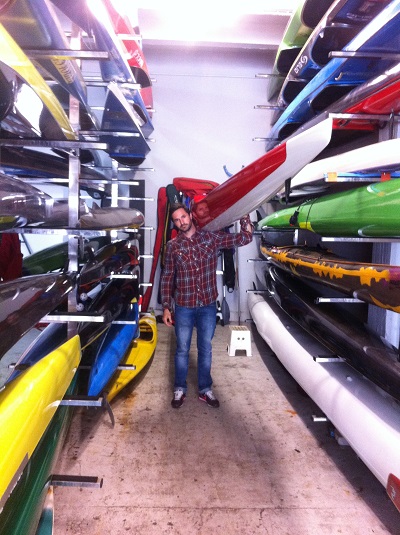
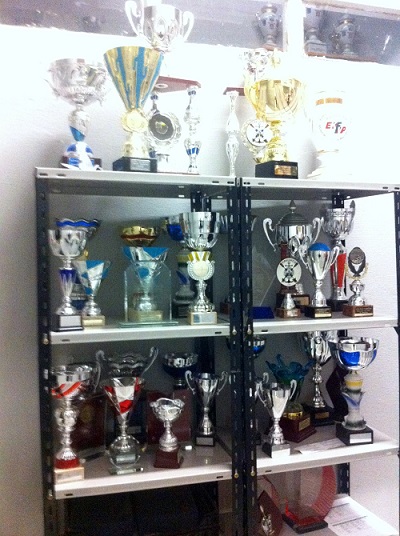
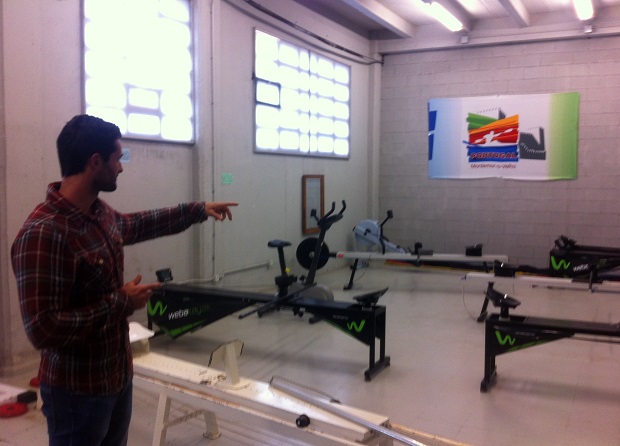
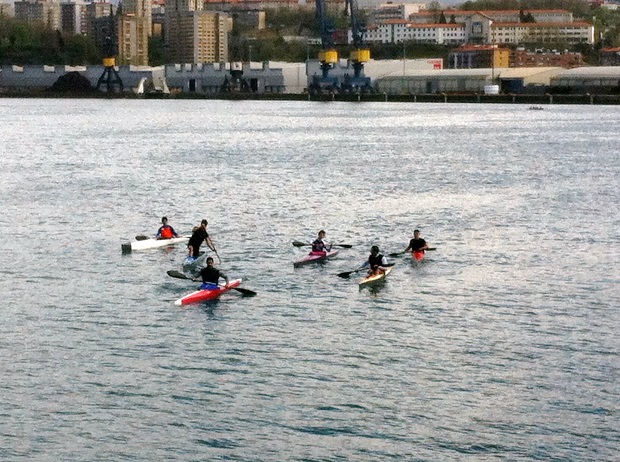
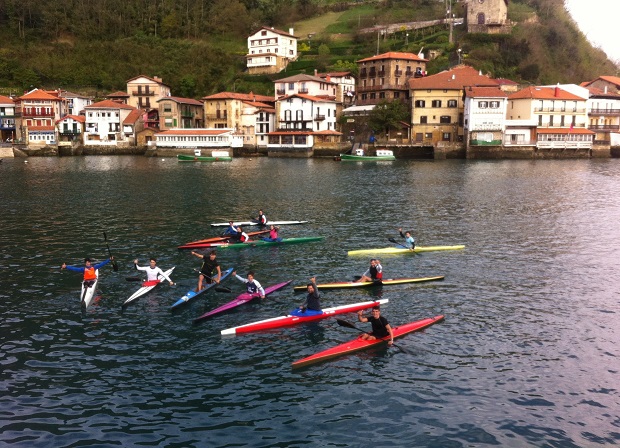
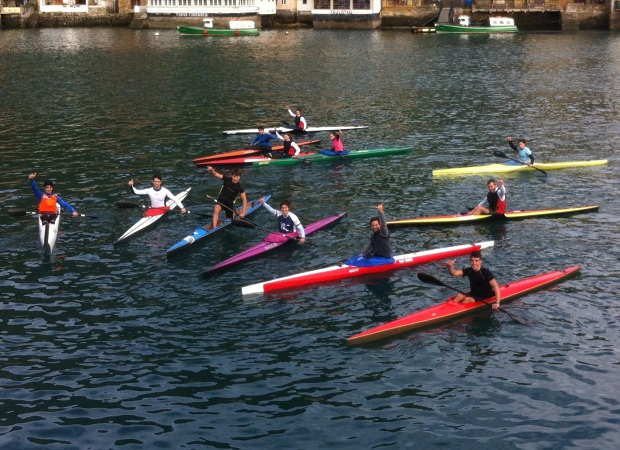
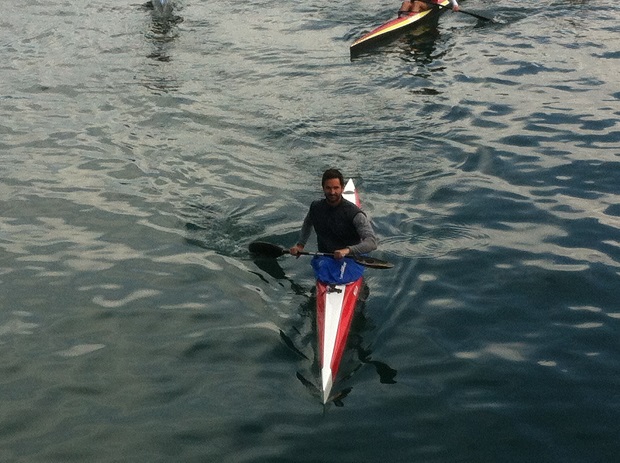
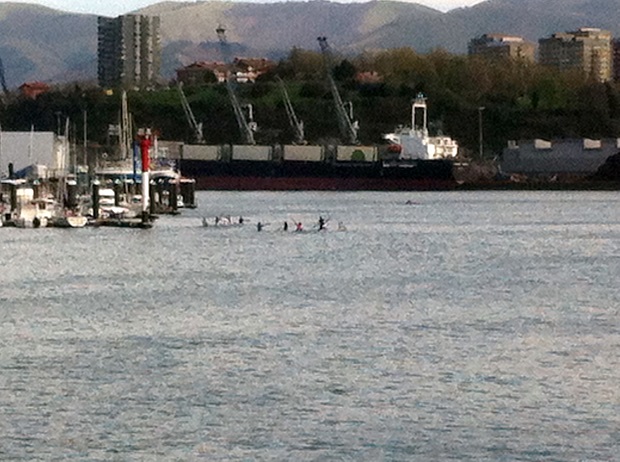
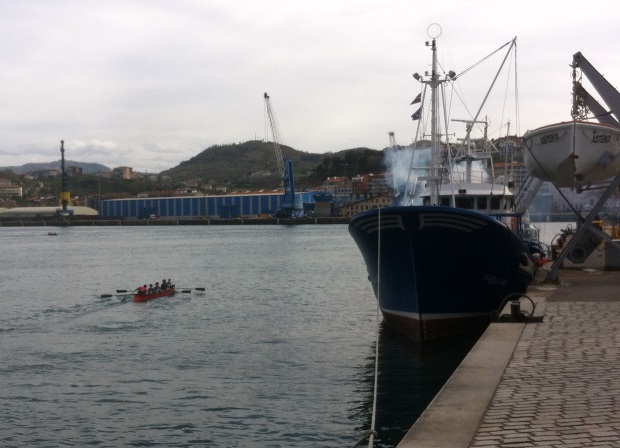
Flatwater coaching; one of the young stars Ekaitz coaches is Bergoña Lazkuno (pictured below) who has a contract with the Basque Federation; he predicts that she has a promising future on the international scene. She has already won a bronze at the Junior World Sprint Championships in 2011 in K4W 500m and competed at the Junior Europeans also in K1 200m – her main focus is to grow as an athlete as she worked towards qualification for Rio 2016. “She was one of three kids that helped me carry my boat to the pontoon when I broke my leg, in exchange I coached them for free that season,” – what a wonderful moment from adversity; candidate for the Pierre de Courbertin Award for Sportsmanship, anyone? You can follow Bergoña's column on Ekaitz's website – she is an aspiring journalist as well.
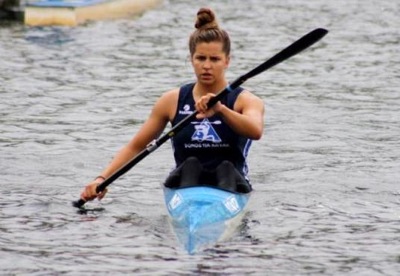 Ekaitz also coaches Amaia Benavente, Bergoña's crewmate and Junior bronze medallist in K4. As for the boys, Ekaitz was proud of Ion Carballo (now U23) who has competed at 2 Junior Marathon World Championships.
Together with his flatwater entourage, Ekaitz trains slalom athletes. Generally-speaking, coaches only specialise in one discipline so it is quite rare for a sprint athlete by trade to teach slalom – his interest in slalom came from growing up with other kayak instructors who practised kayak surf on the beach instead of river paddling as, in San Sebastian, there is only one river nearby and, even then, it only has a single rapid.
“Getting a grasp of what slalom wasn't that easy; it has different variables, they are not as cyclic but more intermittent [than sprint]. By talking to coach Aritz Fernandez and seeing them work everyday helped me to understand these different concepts. Communication and feedback is the key for success in coaching. Some things I applied from flatwater, especially the 200m, like power not hypertrophy – slalom paddlers can't allow themselves to get too big, they must remain flexible.”
Ekaitz and Aritz coach 5 slalom paddlers who made it to this year's Junior World Championships in Penrith, Australia.
Daily life, Olympic qualification and being wheelchair-bound
Returning to our conversation in the café, Ekaitz has faced many challenges in his life which he firmly believes have helped him acquire the positive thinking he has today.
A busy man he is, somehow he manages to train on average twice a day amid his youth and senior coaching career, his academic studies and family responsibilities with a young baby. He puts a part of this work ethos down to his experiences in Australia where he trained for a winter season: “It was really inspirational for me; Ken Wallace, he used to train then work a few hours then go back train again. Jacob Clear would work even more hours and would come [to training] all dusty because he was a plumber I think. We trained at 5.30 in the morning and then again in the afternoon. They were really long tiring sessions. They combined this very well; that's perhaps something that is not intrinsic to our culture.”
 This is the unfortunate reality, many a paddler must work to fund their athletic careers and hard choices have to be made: “I think young paddlers will have to decide between getting a job to work or paddling, rather than just focusing on canoeing like other countries. In the past being a sports-person was a good job, it was a well-considered job [in Spain] I think, there was a lot money involved; superficial money– athletes tried hard to get the money only as a job but the programmes weren't really well-designed. Once the money had been reduced and we had seen cuts, the new generations have seen tougher times. Also, many of them are not studying anything, they're are seeing their twenties pass by and they don't have any education.”
'Fallings-out' with federations and budget-reductions have plagued Spanish canoeing in recent years, cases like David Cal (Spain's most successful Olympian who moved to Brazil to train after his coach's salary was reduced by 14%) have only made these ongoing problems more public, undeniably this is certainly a hindrance to the number of young paddlers coming through the ranks.
Despite this, Ekaitz points out that “we [Spain] keep getting the medals, the athletes are responding well, they keep getting good results regardless of the funding,” and he is right, Spain does have a rich history in medal-winning across paddlesports disciplines, the 'stats' to date speak for themselves: World Championships a) sprint – 14 gold, 17 silver, 27 bronze b) slalom – 1 silver, 5 bronze, c) marathon – 24 gold, 29 silver, 20 bronze d) Olympics – 2 gold, 7 silver, 3 bronze (David Cal had 5 in canoe sprint and Saul Craviotto 2 in kayak sprint (silver in K1 200m at London 2012 and gold at Beijing 2008 in K2 500m with Carlos Pérez). Ekaitz was concerned though that Spanish medal-winning may cease to continue if certain things are not addressed – the clock is ticking.
Some might say that Ekaitz has always been in Saul's shadow, especially when it comes to Olympic selection. Qualification itself is often criticised as not giving opportunities to largest possible number of athletes per country and per event: “My most difficult years were around the Olympics, both Beijing and London – both years I was paddling really well, it was just a matter of luck.” In Ekaitz's case it is quite long-winded to explain but he had a go:
“Before London I won Final B at the World Championship, I was number 10, I think there were 8-9 spots per country, so if you made the A final you automatically qualified, so I had to wait for the European qualifications. The Russians qualified in K1/K2, they moved up 1 place to the B Final. Marco Dragosavljevic from Serbia and I qualified for the Olympics. The year of the Games we had 3 selections races; I made it through to the last one against Saul who won all selection races before, it came down to a head-to-head which he won by 4 one hundredths of a second.”
 Try explaining that to someone who does not follow the sport! Ekaitz felt it was a fair final heat in the end; there was no bitterness towards Saul who went onto win Olympic silver, after all the pair are training partners and friends off the water. Ekaitz was content in achieving his goal of finishing with his own fastest time, yet Saul, the most consistent all season, still beat him by a small margin.
To have the mental determination to keep paddling after the heartache of nearly qualifying for Beijing 1998, then qualifying for London 2012 and not quite making it through to actually compete, knowing that both times you were at your physical peak as well, is a quality few athletes possess. Ekaitz is not drawn to the allure of Olympic gold but by the thrill of living out his life to its most.
His driven mindset could also be attributed to his motorcycle accident back in 2010 where he broke his leg and was left (seemingly indefinitely) wheelchair-bound.
“It gave me a completely different perspective on everything. My whole neck and back were cracked, I could hear noises everywhere. My first worries were 'would I be able to walk?' The doctor gave me good and bad news like in the films, I asked for the good first; 'you haven't broken my neck, you just have a bad concussion on your collar bone', he said. 'The bad is you have broken your ankle in two places, we have to operate'. Everything went from worrying about my health, to paddling again, then to qualifying for the Olympic Games. I don't want to sound too clichéd, but it like having a second chance, to look at how important things are you for you.”
With a swift recovery and a solid support team around him, it wasn't long before Ekaitz was competing competitively again, luckily today he doesn't have any twinges when paddling. Two weeks after being on crutches Ekaitz won the K1 200m 2011 Nelo Winter Challenge – a totally unexpected win for him and everyone around him. Olympic qualification for London 2012 also came round shortly after his accident – all in all remarkable achievements.
“If you get rid of all the pressure from your head, it's amazing what you can do, no expectations, just go out there, enjoy all you've got. It's the journey that is more important than the destination.”
It was his accident that further sparked Ekaitz's desire to dive deeper into the academic world of philosophy, sports psychology and motivation studies including goal-orientation, emotional intelligence, physiology and psychosocial variables athletes face. If you're lucky enough you might even be able to attend one of his lectures at the University of the Basque Country.
As for the future he is taking it year by year at the moment; Rio 2016 could be on the cards as the selection cycle approaches again; “my age will retire me rather than my lack of motivation or motivation to quit!”
Thank you Ekaitz, a memorable and eye-opening interview.
Ekaitz's website: ekaitzsaies.com