
 M. DAWSON
 J. CLARKE
 M. SMOLEN
 E. FER
 C. KUHNLE
 M. CHOURRAUT
 M. BENUS
 F. ANTON
 L. BOZIC
 K. HOSKOVA
 J. FOX
 BREZINSKI/BREZINSKI

 A. PETERS
 V. KHUDZENKA
 E. MEDVECKZKY
 GRIJIC/NOVAKOVIC
 L. QIANG
 M. DE JONGE
 R. POULSEN
 A. CHERVOVA
 S. TARNOVSCHI

 J. MOCKE
 E. LEVEMYR
 S. RAFAEL
 H. TAKAKU

 M. GRAZIANI
 J. EGAN
 N. LJUBEK
 MINDE/HAMAR
 PINTA/MOZZICAFI
 S. LAMMLER
 A. BUSLAIEVA
 M. WEGMAN
 S. REINOSO
The shot clock or 60 seconds rule in canoe polo
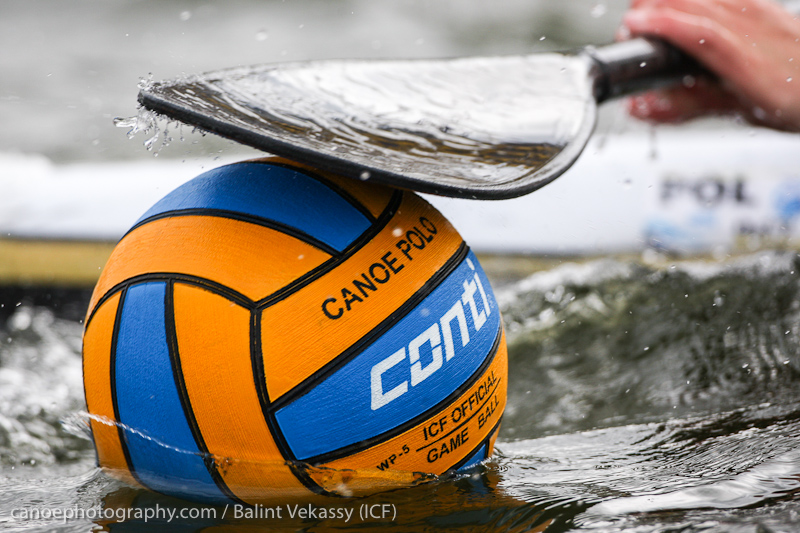
In 2010, following the World Championships held in Milan (Italy), the International Canoe Federation decided to change the rules of Canoe Polo to add a 60 second shot clock rule. Two years later, we asked ICF Grade-A Mr Curly PARKER (GBR) to tell us about the impact this rule has had on canoe polo since then.
What is the shot clock rule?
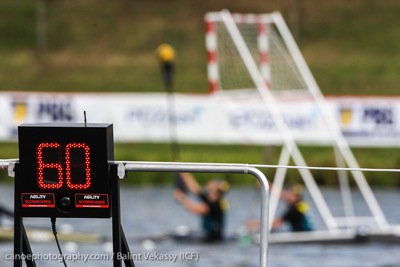
A team must attempt a shot at goal within 60 seconds of gaining possession or control of the ball. Failure to do so will result in possession being awarded to the other team.
What was the main reason to implement the shot clock rule in canoe polo?
"We play a 20 minute game so ending up with a score of about twice as big as soccer was typical, like 4-2 or 6-3. The main driving force for the shot clock rule change was to make canoe polo more attractive to the media. Also I must admit that a small group of teams were happy sometimes with a low scoring win or a tie, for the sake of strategy. Most of the teams were not able to hold the ball for 20 minutes, the game was too physical. Only a few of them were able to score one goal and then keep the ball by accurately covering the field of play. For technicians like me it was very interesting to witness such skills, but I can understand that for the spectator it was not exciting to watch and for the media not exciting to broadcast. For the good of our sport, something needed to be done. Nobody wants to see ten players sitting still in kayaks. The ICF technical committee in consultation with experienced referees explored a few solutions and decided the shot clock would be the most appropriate."
 What were the arguments against the implementation of the rule?
"Tactically a variety of tactics have developed over the years. From the way a team attacks or defends, different nations were approaching the game in a different way. For example in defense playing five on five with no goalkeeper known as pressing in some sports was very exciting technically. The physicality of the teams could lead them to choose a different tactic. The argument against this rule is that when you do not have the ball you just go back to your part of the field and you just defend like in water polo or basketball and wait for a shot and then go to the other end of the pitch. Technically speaking the variety in the game appears less.
The shot clock came in and it has changed the way tactics are used in the game. I think that the people against the shot clock have been right to a certain extent because now all the team have started to play the same way and the midfield play that we had before and that was so beautiful in polo almost disappeared after implementation. But after about a year, teams learnt to adapt to the shot clock and I think now most people, maybe everybody agrees that the rule has been a positive change for our sport."
Why is that?
"Now you can see games of very strong teams like the France, Germany, Netherlands, end up at 9-7 instead of 2-0. Canoe Polo is much more appealing to everyone now. You have to make a shot happen quickly. These are only the first World Championships since the rule was established and the teams have already developed some new approaches. The shot clock is still very new, and I believe that in the next two years, the teams will develop even more tactics to use the clock to help them. Now teams are far more positive in their approach to scoring which provides far more entertainment and action for spectators and media. Canoe Polo continues to move forward.”